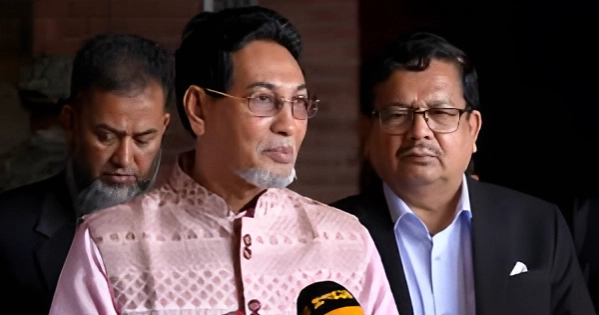
The ruling party BNP remains confident that opposition lawmakers will eventually join the proposed special parliamentary committee on constitutional amendments, Chief Whip Nurul Islam said on Sunday.
“We will work through discussions with them (the opposition). They will definitely join the special committee,” he told reporters after a meeting on renewable energy management at the Parliament.
Asked about the source of his confidence despite the opposition’s current reluctance, the Chief Whip said his long parliamentary experience gave him assurance.
“You may ask why I am so confident. I am confident because I have been in parliament four or five times before. I know that in the end they will join. Ultimately, this is what they will do. The issue will be resolved through dialogue,” he said.
On April 29, Law Minister Md Asaduzzaman proposed in parliament the formation of a 17-member special committee for constitutional reforms and requested the opposition to nominate five members.
Responding to a question about the opposition’s delay in submitting names, Nurul Islam said the opposition MPs are first-time lawmakers and need time to understand parliamentary procedures.
“Why are you asking whether they will give names or not? They certainly will. Most of the opposition MPs have never been members of parliament before. Since this is their first term, they need some time
to understand and adapt to the process. We should allow them that time,” he said.
The Chief Whip also stressed that constitutional amendments are inevitable, noting that Bangladesh’s Constitution has already undergone multiple revisions.
“There are 153 articles in the Constitution. Suppose we amend 50 of them — what will happen to the remaining 100? They will still remain in the Constitution. At the end of the day, amendments must be made. There is no alternative,” he said.
He added that constitutional amendments are common around the world.
“There is no example in the world where a constitution is simply discarded and replaced unless there is a revolution, a mass uprising, or independence. The constitutions of the United States and India have been amended many times. Bangladesh’s Constitution has also been amended 17 times, and this process will continue,” he said.
Replying to another question, the Chief Whip said the current parliament would become “the best parliament in Bangladesh’s history.”
On the repeal of 16 ordinances, including those related to enforced disappearances and human rights, issued during the tenure of the interim government, Nurul Islam said the ordinances would be revised and reintroduced in parliament.
“The 16 ordinances will be brought back to parliament after further scrutiny and strengthening. Those that can be tabled during the current budget session will be presented now; otherwise they will be introduced in a later session,” he said.
The Chief Whip also said discussions had taken place with the Prime Minister regarding the parliament’s sound system.
“We will directly consult globally recognised suppliers so that a durable sound system can be installed. The arrangement will be made in a way that it can function effectively for at least 15 to 20 years,”
he said, adding that the opposition leader would also be involved in the decision-making process.
Highlighting the government’s renewable energy plans, Nurul Islam said the parliament complex had been selected as a pilot site for solar energy generation.
“The Prime Minister has said parliament should become the centre of resolving all national problems. As a symbol of that commitment, we have chosen parliament as the pilot project for solar power generation by installing solar panels on its rooftop,” he said.
He added that the government is increasingly focusing on renewable energy to achieve long-term energy self-sufficiency.
“As part of this initiative, solar panels have already been installed at the parliament building. Gradually, solar panels will also be installed on all government buildings at district and upazila levels,” he said.
The Chief Whip further said the government is considering limiting visitor access during parliamentary sessions due to security concerns.
“It turns into a crowded marketplace here sometimes. Considering security issues, discussions are underway to limit the number of visitors during parliamentary sessions,” he said.