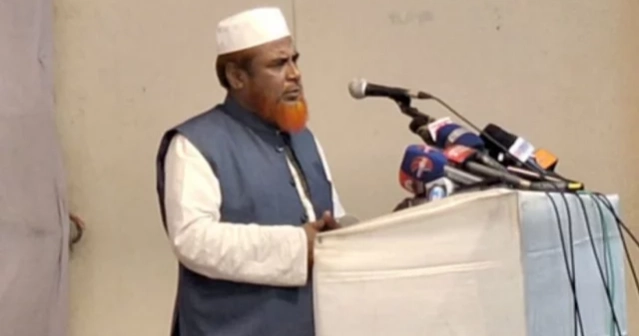
Bangladesh Jamaat-e-Islami on Saturday demanded immediate suspension of all moves to hand over the import, storage and marketing of refined petroleum products to the private sector, calling the government initiative a “new licence for looting.”
Jamaat Secretary General Mia Golam Parwar made the demand in a written statement at a press briefing on the government’s initiative to formulate a new fuel policy at the party’s central office in Moghbazar in the afternoon.
Jamaat 'expects' India to revise stance, hand over Hasina to Bangladesh
He alleged that the government was not speaking publicly about the issue and that the process was being carried out “through conspiracies, behind documents and behind closed doors.”
Referring to a proposed policy to hand over the import, storage, transportation, distribution and marketing of refined petroleum products to private operators, he warned that the decision would ultimately impose a heavy cost on every citizen, including through bus fares, diesel prices at irrigation pumps and the price of rice.
“We want to say clearly: this is not reform; it is a transfer. This is not competition, it is a licence for corruption and looting,” he said.
He said the proposed move would not break a monopoly but would instead result in a one-sided transfer of control.
“It is being said that breaking BPC’s monopoly will bring competition and reduce prices. Instead of breaking a state monopoly, a private monopoly will be created over, due to this move, which the people will have no control, Parliament will have no accountability and there will be no audit,” he added.
Parwar said government institutions could be reformed if they performed poorly, but consumers would have little recourse if private companies raised prices.
He said proponents of privatisation were arguing that Bangladesh Petroleum Corporation (BPC) was inefficient and loss-making and therefore the private sector was needed.
“But the data show that BPC made a net profit of Tk 3,943 crore in 2023-24 and Tk 2,050 crore in 2024-25,” he said.
“The institution being labelled ‘failed’ and prepared to be handed over has deposited thousands of crores of taka in profit into the state treasury in two consecutive fiscal years,” he said.
Parwar said the fuel market was worth around Tk30,000 crore a year.
“If this huge market goes into the hands of a few groups, even an additional profit of Tk1 per litre can turn into thousands of crores of taka in annual looting, making it legal,” he said.
“Why would a private company do what BPC does even at a loss?” he asked.
“The day the decision moves into a company boardroom, Bangladesh will no longer be the owner of its own fuel security,” he said.
Parwar said Jamaat was not opposed to a market economy or private investment.
“We are opposed to an unaccountable transfer of control and the expansion of opportunities for corruption,” he said.
“Competition does not mean transferring a monopoly from one hand to another.
“We want the government itself to move away from this wrong path. The people’s resources must remain in the hands of the people,” he said.
Jamaat demanded the immediate suspension of all moves to hand over the import, storage and marketing of refined petroleum products to the private sector. It also called for all relevant documents, including the draft policy, to be made public and for at least 60 days to be provided for public consultation.
The party further demanded an open hearing under the relevant parliamentary standing committee, with representatives of the opposition, CAB, CPD, university-based energy experts, the workers’ federation and consumers given the opportunity to present their views.
Instead of privatising the sector, Jamaat called for BPC to be reformed through an independent audit, professional appointments to its board, mandatory e-GP in procurement, and the publication of quarterly information on fuel import prices and quantities.
It also demanded that a specific timeline be announced and implemented for the second unit of Eastern Refinery (ERL-2) and for expanding strategic fuel storage capacity. At the same time, the party called for the withdrawal of all recommendations seeking to curtail the legal protection of workers and employees in the energy sector.