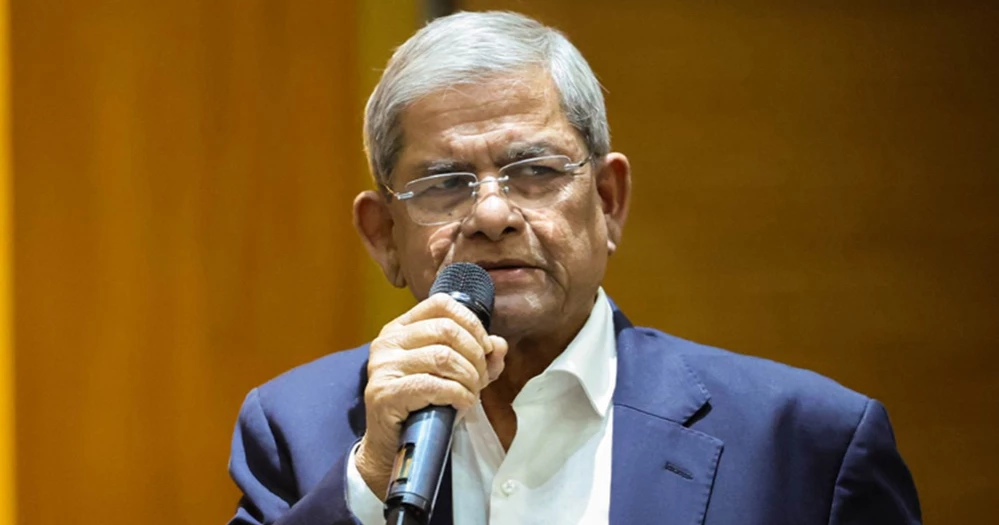
BNP Secretary General and Local Government, Rural Development and Cooperatives Minister Mirza Fakhrul Islam Alamgir on Saturday said Dhaka no longer feels like a livable city, warning that worsening pollution, deteriorating public services, declining institutions and unplanned urbanisation are making life increasingly difficult for residents.
Speaking as the chief guest at the inauguration of the “Dokkhiner Janala” initiative and a seminar titled “Citizen Thoughts and Necessary Actions” organised by Dhaka South City Corporation at a restaurant in the capital’s Paltan area, Fakhrul said the city is facing a multifaceted crisis that requires urgent structural reforms and long-term planning.
Fakhrul says 'democracy under threat,' flags planned digital campaign against government
“Dhaka no longer feels livable. There is hardly an environment where people can breathe freely. Various institutions are approaching destruction. If we fail to come out of this situation, living in the city will become even more difficult for residents,” he said.
Referring to the presence of the Managing Director of Dhaka WASA at the event, Fakhrul expressed deep concern over the capital’s water quality and the deteriorating condition of surrounding rivers.
He questioned why, despite numerous development projects involving thousands of crores of taka, there has been no effective initiative to free the Buriganga River from pollution.
“Will merely raising awareness among citizens solve the problem? Those who formulate policies, govern Dhaka and design development plans must evaluate how much ordinary citizens are actually benefiting from these projects,” he said.
The minister stressed that city governance requires stronger commitment, improved planning and greater accountability from elected representatives and urban authorities.
“Dhaka is our home. But nowadays I sometimes feel I would rather return to my hometown than continue living in this city,” he said.
He cited air pollution, overcrowded public hospitals and the deteriorating condition of public institutions as major concerns affecting the quality of life in the capital.
“Step outside and the air you breathe is polluted. Visit a public hospital and you can hardly enter because of the conditions there. Every institution seems to be moving towards decline,” he said.
Recalling his student days, Fakhrul said he used to enjoy boat rides on the Buriganga after arriving in Dhaka as a college student in 1963.
“At that time, we would often travel on the Buriganga by boat. Today it is almost impossible to go near the river because of the pollution and foul smell,” he said.
He added that the condition of the Buriganga has become so severe that it may now be contributing to many of Dhaka’s environmental and public health problems.
The minister also expressed concern over the deteriorating condition of the Shitalakkhya River, saying city residents would have nowhere to turn if the rivers surrounding Dhaka continue to degrade.
He stressed the need for structural reforms and proper urban planning rather than project-based approaches that end once construction is completed.
“Projects should not end once construction is completed. Their long-term impact and sustainability must be ensured,” he said.
Referring to recent cabinet discussions on Dhaka’s water situation, Fakhrul said a significant portion of the city’s water remains unsuitable for consumption.
He also warned about the rapid depletion of groundwater levels, saying the situation could create serious risks in the event of a major natural disaster such as an earthquake.
“The groundwater level has dropped alarmingly. This poses a serious threat to Dhaka in the future,” he said.
Fakhrul said restoring the rivers surrounding Dhaka must become a national priority.
“So many projects are undertaken, but there is no dedicated project to make the Buriganga pollution-free. I am repeating this because I believe we must seriously discuss what can be done to restore the Buriganga, the Turag and our other rivers,” he said.
He lamented the lack of planned urbanisation despite the city’s rapid population growth over the decades.
“Population growth and urbanisation are natural, but development has not been properly planned. Drainage systems are either inadequate or ineffective. Thousands of crores of taka are spent on drainage projects, yet water often fails to drain properly,” he said.
The minister expressed hope that future city corporation leaders elected through upcoming local government elections would address these challenges with greater seriousness.
He said the Local Government Ministry would treat the matter as a priority and welcome expert recommendations on improving Dhaka’s livability.
“We want to know what measures the government can take so that citizens of Dhaka can once again breathe freely and enjoy a better quality of life,” he said.
Referring to the “Dokkhiner Janala” initiative, Fakhrul said the city must be transformed into a place where residents can genuinely enjoy a healthy, clean and open environment.
“We must create a Dhaka where people can truly open their windows and breathe freely,” he added.