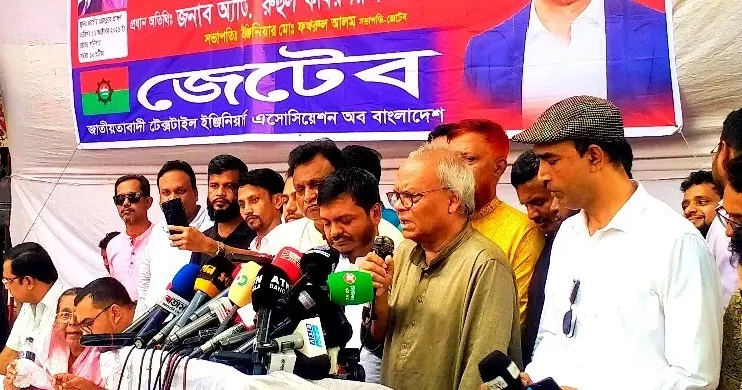
BNP Acting Secretary General Ruhul Kabir Rizvi on Saturday accused opposition parties of staging fresh political dramas in the streets to conceal their internal conflicts and failures, saying they were trying to mislead people instead of playing a constructive role amid the country's various challenges.
“Whenever you open a newspaper, you see the opposition parties only talking about what is lacking and what has ended. They have no concern for the country's development or people's welfare,” he said.
He made the remarks as the chief guest at a protest rally held in front of the National Press Club in the noon.
The Jatiyatabadi Textile Engineers Association of Bangladesh (JTEB) organised the rally to protest what it described as planned anarchy and conspiracies by the Awami League across the country.
Rizvi said opposition parties are looking for new excuses to take to the streets and arranging various programmes to cover up their internal divisions.
He said opposition parties had previously organised long marches and were planning further programmes on issues including the July Charter, while different parties in their alliances continued making various statements.
The BNP leader also referred to criticism of the government's social protection programmes, including the Family Card, Farmer Card, Expatriate Card and Health Card.
“You may criticise the government, but speak the truth and make reasonable arguments. If you try to mislead people with falsehoods, they will never believe you,” he said.
Rizvi accused opposition parties of focusing on finding faults and organising political programmes instead of recognising these initiatives.
He said people are increasingly questioning whether such activities were intended to conceal internal conflicts within opposition parties that had become visible in different places.
Rizvi said the government is working day and night to keep supplies as normal as possible despite the crisis.
He said Bangladesh imported fertiliser from Saudi Arabia and the United Arab Emirates (UAE), adding that a UAE fertiliser shipment had already arrived at Mongla port.
He said the fertiliser shortage, which had been anticipated and had affected supplies to some extent, is now being addressed through the government's efforts.
He said another fertiliser shipment from Saudi Arabia was being prepared and was expected to arrive within a few days.
With the winter growing season approaching, he said, fertiliser was essential for cultivating potatoes, tomatoes, cabbages and cauliflowers.
The government had made preparations to ensure supplies for the season, he said, adding that fertiliser imports from the UAE, including Dubai, and Saudi Arabia were part of those efforts.
Rizvi said a people-oriented government should formulate policies by considering the suffering and hardships of ordinary citizens.
Rizvi also referred to remarks by an Indian minister who reportedly said that a conspiracy was underway to overthrow the government in India, similar to the way the government in Bangladesh had been removed.
He said Bangladesh had the right to respond when comments about political developments in another country referred to events in Bangladesh.
Rizvi said mass movements emerged when rulers governed unjustly or illegally, adding that the circumstances surrounding the fall of Sheikh Hasina's government should be understood in that context.
Referring to the reported remarks by an Indian minister that a conspiracy is underway to topple the Indian government, similar to the ouster of the government in Bangladesh, Rizvi said Bangladesh had the right to respond when it was referred to in such comments.
“Whatever is happening in a neighbouring country is not something we need to comment on. But when Bangladesh is referred to, we have the right to speak,” he said.
Addressing the Indian minister, Rizvi said mass movements, popular awakenings and uprisings could emerge when a country was governed unjustly and unlawfully, forcing rulers accused of wrongdoing to flee.
He said Sheikh Hasina had not been a legitimate ruler, alleging that she had repeatedly remained in power by undermining elections and denying people their voting rights.
“Ultimately, she was forced to flee in the face of a massive uprising by students and the public,” Rizvi said, adding that this was the fate of rulers who committed crimes and acted against the interests of the people.