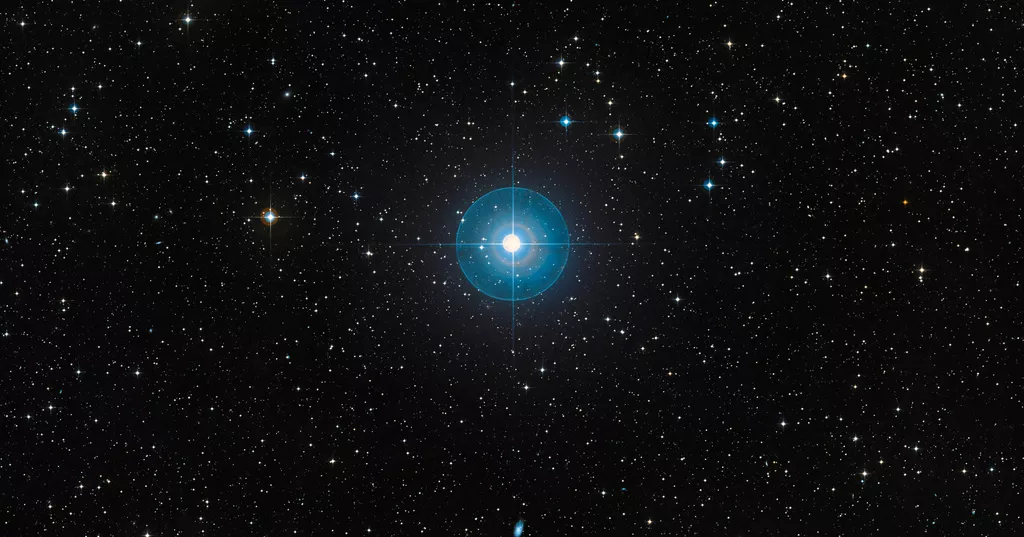
Astronomers have identified a faint giant exoplanet orbiting the young star Beta Pictoris after it remained undetected for more than a decade, marking the dimmest planet ever directly imaged from Earth.
The discovery was made independently by two research teams within days of each other late last year using different telescopes, according to findings published Wednesday in The Astrophysical Journal Letters.
One team, led by scientists from Scotland and Germany, detected the planet using the European Southern Observatory’s Very Large Telescope in Chile. Researchers later examined archival observations and confirmed that the planet had been hidden in earlier data, obscured by the brightness of its host star and two previously known companion planets.
“It was very much playing hide-and-seek for 11 years,” said Markus Bonse of the European Southern Observatory, who co-led the research.
A separate team led by researchers from the University of California, San Diego, made the same discovery using NASA’s James Webb Space Telescope. Scientists said only two observations with the space telescope were needed to identify the elusive world.
Both teams had been studying one of Beta Pictoris’ already known planets when they independently spotted the much fainter object, estimated to be around 100 times dimmer and located farther from the star. Researchers intentionally kept their work separate to avoid influencing each other's findings.
The newly discovered planet is slightly larger than Jupiter and takes about 91 years to complete one orbit around its star, comparable to Uranus’ orbital period around the Sun.
Scientists believe the planet resembles a much younger version of Jupiter because it formed in a planetary system that is only about 20 million years old, compared with the Sun’s age of roughly 4.5 billion years.
According to researcher Aidan Gibbs, the system offers a rare opportunity to study the early stages of planetary evolution, when giant planets have already formed but smaller rocky planets may still be developing.
Beta Pictoris is located about 63 light-years from Earth in the southern constellation Pictor.
NASA says fewer than 100 of the more than 6,000 confirmed exoplanets have been detected through direct imaging, with most discovered using indirect methods such as observing the slight dimming of a star when a planet passes in front of it.
Researchers hope the newly identified planet will provide fresh insights into how young planetary systems evolve over time.