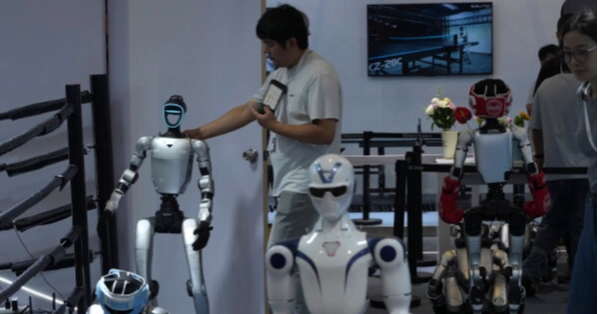
Unitree, a leading Chinese humanoid robot manufacturer, saw its shares surge in spectacular fashion during its debut on the Shanghai Stock Exchange on Wednesday, reflecting strong investor confidence in China’s growing technological capabilities.
The company’s stock jumped as much as 629% after trading began on the STAR Market. By midday, the shares remained nearly 500% above their initial offering price of 150.80 yuan ($22.36).
Founded in 2016 by entrepreneur Wang Xingxing in Hangzhou, Unitree raised approximately 6.1 billion yuan ($904 million) through its initial public offering. The listing makes it the first humanoid robotics company in mainland China to become publicly traded.
Humanoid robotics, widely regarded as a form of “embodied” artificial intelligence, has emerged as an important front in the technology competition between China and the United States. China currently has an advantage in both humanoid robot production capacity and its ability to expand manufacturing on a large scale.
According to technology research and advisory firm Omdia, around 15,000 humanoid robots were shipped worldwide last year. Chinese companies dominated the market, with Unitree and fellow manufacturer AGIBOT each accounting for more than 5,000 shipments, significantly exceeding their American competitors.
Despite the rapid growth, analysts caution that humanoid robots have yet to become widely established in everyday commercial and industrial settings. Many are still primarily used for demonstrations, entertainment and research. Unitree’s robots, for instance, attracted widespread attention after performing backflips and martial arts routines during China’s annual Spring Festival gala.
Morningstar investment analyst Kangyuxiao Li said the industry’s real test would be whether robotics companies could deliver dependable performance while generating worthwhile returns from large-scale industrial and commercial applications.
Unitree plans to use the money raised from its IPO to strengthen research and development in advanced robotics and build up its robot manufacturing facilities.
The company’s successful listing could also influence how other robotics firms are valued when they seek to enter the stock market. According to Li, the IPO gives investors on the mainland direct access to one of the leading companies in the rapidly expanding sector.
Another major Chinese humanoid robot manufacturer, UBTech, is already listed in Hong Kong. Its shares dropped 10.6% on Wednesday.
Unitree recorded revenue of about 1.7 billion yuan, or roughly $250 million, in 2025. Its income came mainly from humanoid robots and four-legged robotic machines commonly known as robot dogs. More than 40% of the company’s revenue came from overseas markets.
The United States accounted for about 13% of Unitree’s revenue last year. However, the company now faces uncertainty in that market after the U.S. Federal Communications Commission imposed a ban in July on imports of new foreign-made humanoid and quadruped robots, citing national security concerns.
Unitree said the restriction applies to its newer models and could hurt future sales in the United States. Although some existing models can continue to be sold, the company warned that Washington could broaden the restrictions in the future.