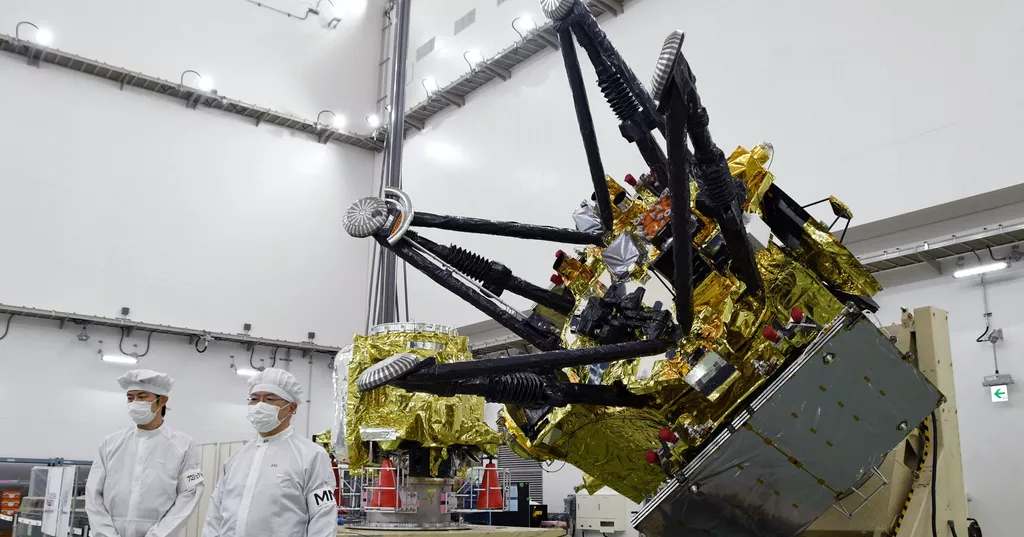
Japan is preparing to launch a spacecraft on Tuesday on a five-year mission to collect and return samples from Phobos, one of Mars' two moons, in a bid to uncover clues about the formation of the moons and the origins of the solar system.
The Japan Aerospace Exploration Agency (JAXA) will launch the Martian Moons eXploration (MMX) spacecraft aboard its H-3 rocket. It will be the first mission aimed at bringing samples back to Earth from a moon of Mars.
Scientists hope the findings will help determine whether Phobos and its smaller sibling, Deimos, formed from debris following a major impact on Mars or are asteroids captured by the planet's gravity.
The mission is led by Japan with equipment and communications support from NASA and other international space agencies.
MMX project manager Yasuhiro Kawakatsu said studying Phobos could also help scientists assess the potential use of a Martian moon as a base for future crewed missions to Mars.
Although numerous spacecraft have explored Mars since the 1960s, its two moons remain poorly understood. Phobos is about 20-30 kilometres in diameter and orbits roughly 6,000 kilometres from Mars.
JAXA principal investigator Kiyoshi Kuramoto said analysing samples from Phobos could help scientists reach a clearer conclusion about the moons' origins.
Researchers chose Phobos because it is closer to Mars than Deimos and may contain more material from the planet. JAXA estimates that about 0.1 percent of the collected material could consist of Martian debris.
After launching, the spacecraft is expected to reach the Mars region around August 2027. It will spend about three years studying Phobos, collecting data and gathering samples before returning to Earth in 2031. The mission also includes a flyby of Deimos to gather additional observations.
The roughly five-tonne spacecraft has three modules for propulsion, exploration and sample return. It will carry 13 instruments, including a rover jointly developed by France and Germany, a NASA sampling device and a European Space Agency communications instrument.
The French-German rover, named Idefix, is expected to land on Phobos around 2029 and explore its surface for about 100 days to help identify suitable sites for sample collection.
JAXA aims to collect at least 10 grammes of material through two sampling attempts. The spacecraft will use US-developed equipment to collect surface dust and a Japanese coring device to obtain material from about two centimetres below the surface.
The samples will be stored in a heat-protected capsule designed to withstand re-entry into Earth's atmosphere. The capsule is expected to land in Australia before being transported to Japan for analysis.
Scientists say material collected from different locations could improve the chances of identifying traces of past microbial life originating on Mars.
Landing on Phobos presents significant technical challenges because the moon has extremely weak gravity, about one-two-thousandth of Earth's, and a heavily cratered surface. The spacecraft's exploration module has shock-absorbing landing gear designed to reduce bouncing, while the rover is equipped to maintain traction and recover if it tips over.
Japan previously returned asteroid samples through its Hayabusa missions in 2010 and 2020.