
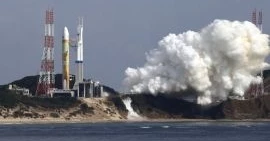
Japan's flagship H3 rocket successfully returned to flight on Friday, marking an important milestone for the country's space program with the debut of a lower-cost version aimed at improving its position in the increasingly competitive global space industry.
The rocket lifted off from the Tanegashima Space Center in southwestern Japan and successfully placed its second stage into the planned orbit, according to the Japan Aerospace Exploration Agency (JAXA), which broadcast the launch live.
JAXA also said six small satellites developed by universities and other organizations were believed to have been successfully deployed.
The mission was the first launch of the H3's new "30 configuration," a more affordable version powered by three liquid-fuel LE-9 engines and no rocket boosters. The model is designed to reduce launch costs and make the H3 more attractive to customers. It is one of three planned versions of the rocket intended to serve different mission requirements.
Friday's launch was the sixth successful mission for the H3 program and came after two earlier failures, raising confidence in Japan's next-generation launch vehicle.
The H3 replaced the long-serving H-2A rocket, which had built an impressive record of successful launches. Japan developed the H3 to offer a more cost-effective option in the global launch market, where competition is led by Elon Musk's SpaceX.
Japanese officials consider a reliable and commercially competitive launch system essential for both the country's space ambitions and national security.
The H3 faced difficulties during its first launch in March 2023 when its second-stage engine failed to ignite. Another setback occurred in December when a malfunction in the same stage prevented a navigation satellite from reaching its intended orbit.
The rocket had remained grounded since that December failure, and another unsuccessful mission would have dealt a serious setback to Japan's future space plans, including a Mars mission targeted for 2028.
Japan's smaller Epsilon S rocket program has also faced delays after a test vehicle caught fire in 2024.
JAXA and co-developer Mitsubishi Heavy Industries hope to increase the launch rate of the H3 rocket to between six and eight missions a year in the future.