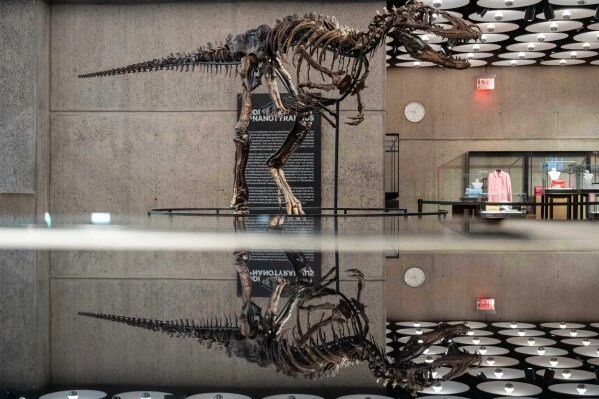
A rare dinosaur skeleton resembling a miniature Tyrannosaurus rex has sold for $47.3 million at an auction in New York, making it one of the most expensive dinosaur fossils ever sold.
The skeleton, nicknamed “Jodi,” belongs to a Nanotyrannus, which scientists recently confirmed was a distinct dinosaur genus and a distant relative of T. rex, rather than a juvenile specimen of the larger dinosaur.
Sotheby's said the fossil was sold to an unidentified buyer on Tuesday after a roughly 12-minute auction. The winning bidder outcompeted five other prospective buyers participating online and by phone. The auction house had estimated the skeleton would sell for between $6 million and $9 million.
The sale makes “Jodi” the second-most expensive dinosaur fossil ever sold. Earlier this summer, a T. rex skeleton known as “Gus” fetched a record $50.1 million at Sotheby's.
Nanotyrannus was about half the length of an adult T. rex. Both dinosaurs lived during the Cretaceous period around 67 million years ago. Nanotyrannus had relatively longer forelimbs, larger hand claws and narrower, blade-like teeth.
“Jodi” is one of only three known Nanotyrannus skeletons. Standing 9 feet 6 inches (2.9 metres) tall and measuring nearly 20 feet (6 metres) long, the specimen is estimated to be almost 70% complete. It has been displayed at Sotheby's headquarters in upper Manhattan since earlier this month.
The fossil was discovered in 2019 on a Montana ranch owned by Jodi Pierson, after whom the dinosaur was named.
Sotheby's praised the professional fossil hunters who discovered and excavated the specimen, whose work was featured in the Discovery Channel documentary series “Dino Hunters” in 2020.
Cassandra Hatton, the auction house's head of science and natural history, said their dedication to studying and preserving the fossil demonstrated how individuals could contribute significantly to scientific knowledge.
However, some scientists have criticised the private sale of important fossils, arguing that such specimens should be kept in museums or research institutions, where scientists can study them and the public can view them.
For decades, researchers debated whether Nanotyrannus was a distinct dinosaur or simply a young T. rex. Research published last year concluded that it represented a separate genus.