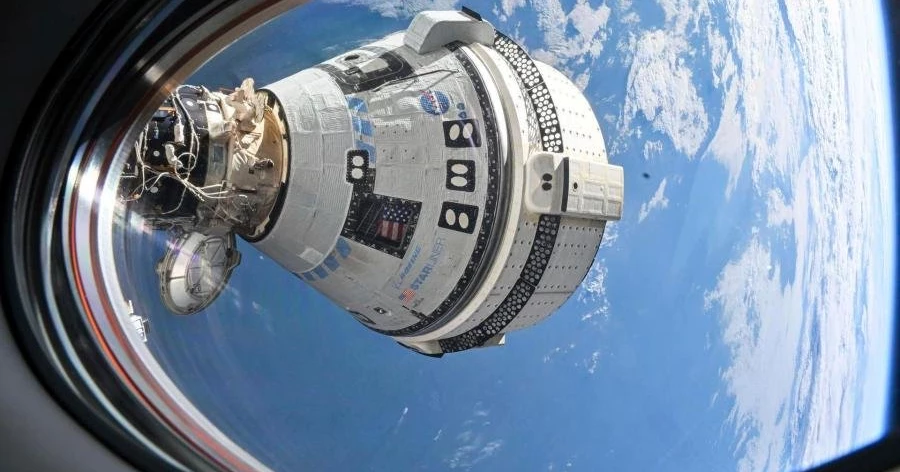
NASA is providing additional support and funding to help Boeing fix its troubled Starliner spacecraft and return it to service as soon as possible.
The Starliner faced a series of problems during a 2024 test flight, leaving its two astronauts, Butch Wilmore and Suni Williams, at the International Space Station for nearly a year. NASA later classified the mission as a crew-endangering “Type A mishap,” the agency’s most serious category.
NASA Administrator Jared Isaacman said Monday that Boeing is expected to launch an upgraded Starliner to the space station by December. The spacecraft will carry cargo but no astronauts.
Astronauts are not expected to fly aboard Starliner again until 2028, as NASA and Boeing work on safety improvements that could take months or longer to complete.
Dana Weigel, a NASA manager, said all of Starliner’s problems must be fully addressed before astronauts return to the spacecraft.
“Bottom line: We’re on the right path,” said NASA astronaut Woody Hoburg, who will command the next Starliner mission.
Hoburg described Wilmore and Williams, who have since retired, as “American heroes” and said he was honored to follow them.
NASA had sought two U.S.-based systems for carrying astronauts to and from orbit after the space shuttle program ended. The agency awarded billions of dollars to Boeing and SpaceX to develop those services.
SpaceX became the first private company to send astronauts into orbit for NASA in 2020 and is preparing for its 14th crewed NASA mission later this week.
After two uncrewed Starliner test flights, Boeing finally sent Wilmore and Williams to the space station. However, the astronauts eventually returned to Earth aboard a SpaceX spacecraft about nine months later.
SpaceX is planning to gradually move away from its Falcon 9 rockets and Dragon capsules in favor of its larger Starship, which reached orbit for the first time Monday.
That has increased NASA’s interest in getting Starliner back on track. Weigel said additional Starliner upgrades and new rocket certifications will cost NASA another $359 million. The planned fixes include replacing valves and seals.
The International Space Station is expected to be retired and brought down from orbit by 2031. Meanwhile, several U.S. companies are developing private space stations that will require dependable spacecraft to transport astronauts and supplies.
SpaceX’s Starship is too large for such docking missions, while the company’s main goals include travel to the moon and Mars.
Asked why NASA does not abandon Starliner and seek another option, Isaacman said the agency remains committed to completing the project with Boeing.
“We always were committed to seeing this through with Boeing,” he said, adding that the program is now “on a very good path.”