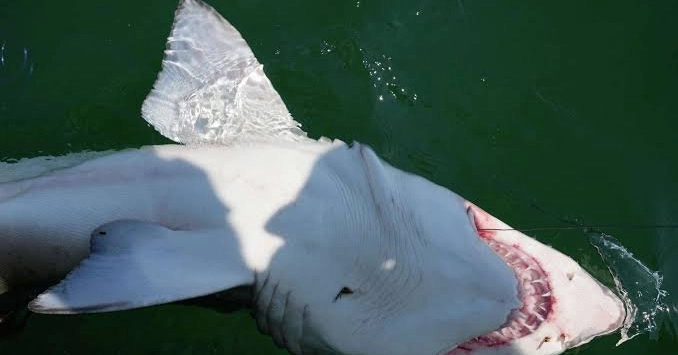
Just off the coast of New York’s famous Hamptons beaches, marine researcher Greg Metzger reels in one of the day’s most impressive catches — a young but powerful sand tiger shark.
Working quickly, Metzger and another researcher secure the sharp-toothed female shark alongside their boat. They collect tissue samples and attach small tracking devices before releasing it back into the ocean.
Metzger said the shark’s tough skin was so strong that it could even damage a surgical-grade scalpel.
“It’s no surprise that they’ve survived since prehistoric times and are still going strong,” he said.
Metzger and other scientists are catching, tagging and releasing different species of sharks to better understand their populations and movements around Long Island.
The research is also helping scientists learn more about one of the world’s few confirmed nurseries for great white sharks, where large numbers of young sharks spend their early years feeding and growing. Other recognised great white shark nursery areas are located off the coasts of California, Mexico and Australia.
Metzger, who also teaches marine science at Southampton High School, said researchers hope their work will help change public perceptions of sharks.
Many people fear sharks, but he said they are far more complex than the “mindless eating machines” often shown in popular culture.
Tracking sharks across thousands of kilometres
Researchers use different types of electronic tags to follow the sharks. Some send acoustic signals that can be detected by monitoring stations along the coast, while others record information such as water depth and temperature before eventually detaching from the animal.
The tracking data shows that some sharks travel vast distances during the year.
Bradley Peterson, a marine scientist at Stony Brook University, said sharks tagged near Long Island have later been detected in waters off North Carolina, Georgia, Florida and the Gulf of Mexico before returning north the following year.
Many of them appear to travel to Long Island during the warmer months to feed and build up energy.
Scientists are also seeing a wider variety of shark species in the area.
Frank Quevedo, executive director of the South Fork Natural History Museum and Nature Center, said warmer coastal waters may be encouraging more species normally found farther south to move north during the summer.
Researchers have recently observed more spinner sharks, blacktip sharks and bull sharks in the region.
However, Metzger said sharks have always been present in Long Island waters. He believes people are simply seeing them more often because of modern technology, including drones and mobile phone cameras.
The International Shark Attack File has no record of a fatal shark attack on Long Island, although several people have been bitten in recent years, including one incident this summer. Local authorities have introduced additional safety measures, including drones to spot sharks near beaches.
Learning more about young great white sharks
Scientists are particularly interested in the young great white sharks that use the waters off Long Island as a nursery.
According to Quevedo, newborn great whites can already measure about 4 feet (1.2 metres) and weigh up to 80 pounds (36 kilograms). Unlike many animals, they receive no care from their mothers and must survive on their own from birth.
The relatively shallow coastal waters provide young sharks with a place to feed on schools of fish while avoiding larger predators, including adult sharks.
As they grow, great white sharks move north in search of larger prey, particularly seals along the coast of Cape Cod in Massachusetts.
But scientists have observed that warming waters may be encouraging young great whites to move into New England earlier than before, potentially bringing them closer to adult sharks.
Research aims to support shark conservation
Scientists also hope the research will encourage greater efforts to protect sharks.
Quevedo said the release of the novel and later film Jaws more than 50 years ago contributed to a rise in recreational shark fishing, including the hunting of great white sharks off the Hamptons.
Because great white sharks do not begin reproducing until they are in their 20s or even later, killing younger sharks can have a serious impact on their populations.
Conservation efforts in recent decades have helped some shark populations recover, although their numbers are still believed to be far below historical levels.
Quevedo said sharks, particularly top predators, play an important role in maintaining healthy marine ecosystems.
Protecting them, researchers say, is not only important for the survival of sharks but also for maintaining the balance of the ocean environment.