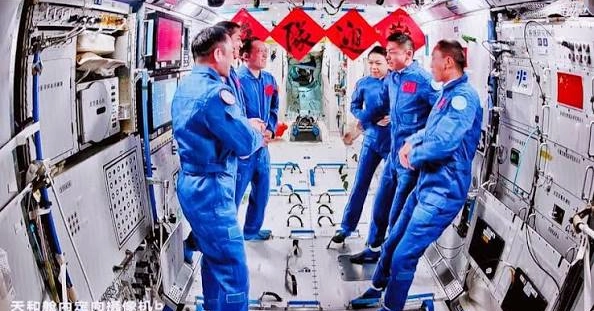
Shenzhou-23 spaceflight mission's three-person crew have successfully tested an upgraded in-orbit mass measurement device at the country's space station as they near their 50th day in orbit while continuing an expanding range of scientific experiments.
According to a video released by the China Manned Space Agency (CMSA) , astronauts Zhu Yangzhu, Zhang Zhiyuan and Li Jiaying also carried out several experiments over the past week focusing on space life sciences and human research.
China achieves rocket fuel breakthrough with LNG-derived methane
As part of a musculoskeletal loading study, the crew conducted plantar pressure measurements, lower-limb biomechanical tests, and muscle-tendon assessments while running and performing resistance exercises under different load conditions. The experiments collected data on plantar pressure, joint movement, motion images and muscle parameters to help researchers understand changes in muscle-tendon interactions in space.
The astronauts also used near-infrared brain functional imaging equipment to carry out neuroergonomic experiments involving multiple tasks. Scientists on the ground will analyze the data to examine how the space environment affects astronauts' cognitive control.
The crew continued its routine daily exercise programme to reduce the physiological effects of prolonged exposure to weightlessness.
China launched the Shenzhou-23 crewed spacecraft on May 24. The mission includes a one-year in-orbit stay experiment designed to provide key data for future long-duration human space exploration.