
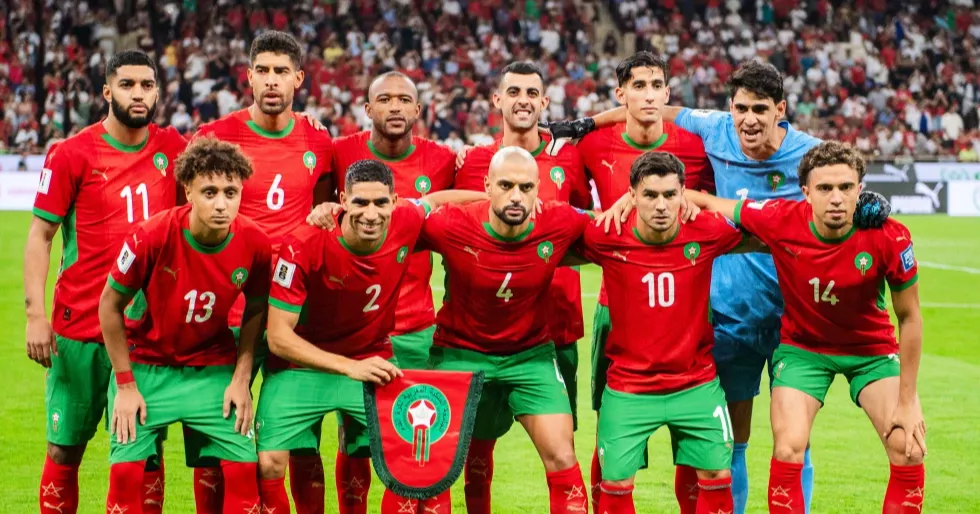
Morocco head into this year’s World Cup with renewed pressure to prove themselves, as off-field controversies and legal disputes overshadow the momentum built from their historic 2022 semifinal run.
The Atlas Lions stunned the football world in Qatar by becoming the first African nation to reach the World Cup semifinals, defeating heavyweights Spain and Portugal along the way. Their achievement also boosted support across Africa and strengthened Morocco’s bid to establish itself as a football powerhouse, including its role as a co-host of the 2030 World Cup.
However, their recent buildup has been marked by controversy following the Africa Cup of Nations hosted in Morocco. A chaotic final against Senegal in January ended in confusion and later legal disputes. Senegal initially lifted the trophy after a 1-0 extra-time win, but the Confederation of African Football (CAF) later ruled in March that Senegal should forfeit the match due to players walking off in protest. The decision overturned the result in Morocco’s favour, but Senegal has since appealed to the Court of Arbitration for Sport, leaving the outcome unresolved and celebrations muted.
The turmoil has shifted focus away from football, with Morocco now looking to reset ahead of a demanding World Cup campaign.
Morocco will face five-time champions Brazil at New York New Jersey Stadium on June 13, Scotland in Boston on June 19, and Haiti in Atlanta on June 24 in their Group C fixtures.
Former coach Walid Regragui, who guided Morocco to their 2022 World Cup breakthrough shortly after taking charge, stepped down following the Africa Cup. Despite earlier success, he faced criticism over the team’s performances at the 2023 Africa Cup of Nations.
He has been replaced by Mohamed Ouahbi, who previously led Morocco’s under-20 side to the Youth World Cup title in 2025. Under his leadership, Morocco drew with Ecuador and defeated Paraguay in March warm-up matches.
Injuries have also posed concerns, with captain Achraf Hakimi struggling with a thigh problem that puts his World Cup participation in doubt. Hakimi had also returned late from injury during the Africa Cup but played a key role in the knockout stages.
Attention has also centred on Brahim Díaz, who starred at the Africa Cup with five goals. The Real Madrid forward was pivotal in Morocco’s run to the final but came under scrutiny after missing a decisive penalty in the controversial final against Senegal. He has since seen limited involvement under the new coach.
With both expectation and uncertainty surrounding the squad, Morocco enter the tournament determined to put off-field distractions behind them and replicate their historic World Cup success.