
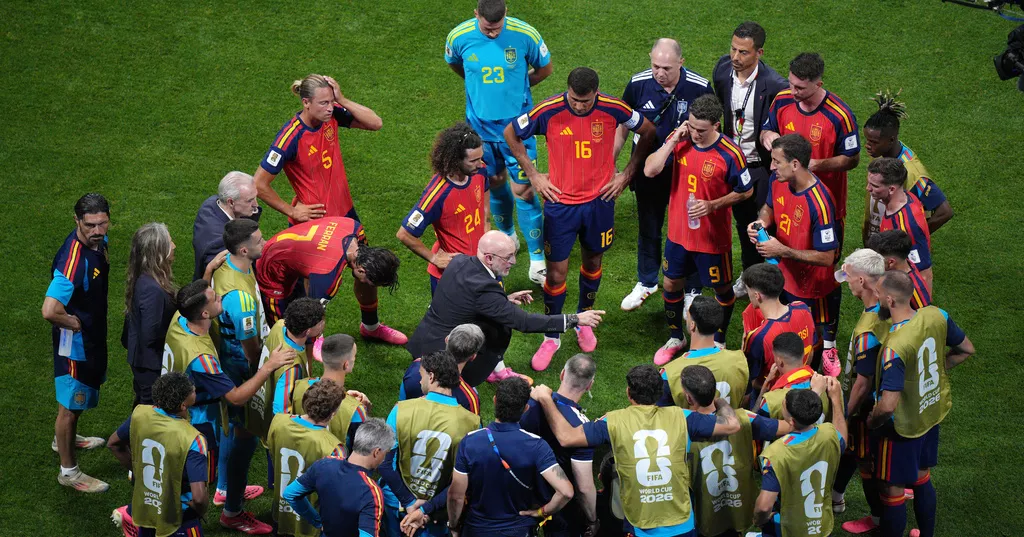
FIFA’s decision to introduce mandatory hydration breaks for the first time in World Cup history has sparked debate among experts, coaches and scientists, as concerns grow over extreme heat conditions in the tournament co-hosted by the United States, Mexico and Canada.
Under the new rule, all matches include three-minute cooling breaks midway through each half, regardless of temperature or whether stadiums are air-conditioned or enclosed. FIFA said the measure is intended to “ensure equal conditions for all teams in all matches,” drawing on lessons from previous tournaments, including last year’s FIFA Club World Cup in the US, where temperatures rose into the 90s Fahrenheit (mid-30s Celsius) and higher in several venues.
Some critics argue the breaks disrupt match rhythm and could allow coaches to influence momentum, while others say they are too short to have a meaningful effect on cooling and rehydration in extreme conditions. Some coaches have also questioned the need for such breaks in every match, not only in high heat.
Joshua L. DeVincenzo, assistant director of applied research services at Columbia University’s National Center for Disaster Preparedness, said the breaks are designed to reduce the risk of incidents linked to heat stress and medical emergencies.
Experts warn that even elite athletes face risks of exertional heat illness in hot and humid conditions, where the body overheats and places strain on the heart, muscles, nerves and central nervous system.
Symptoms may include cramps, fatigue, nausea, dizziness, headache, dehydration and reduced performance. In severe cases, when body temperature exceeds 105°F (40.5°C), athletes may experience confusion, aggression or loss of consciousness — signs of heat stroke requiring urgent medical attention, said Yuri Hosokawa of Waseda University. She has also called on FIFA to extend cooling breaks to at least six minutes.
Experts note that exertional heat stroke is among the leading causes of death in athletes. Dehydration further increases risk, with players often losing 1–2 litres of sweat per hour and sometimes failing to fully replace fluids. Losing as little as 2% of body weight due to dehydration can significantly affect performance.
Ryan Calsbeek, professor of biological sciences at Dartmouth College, said human performance improves with warmth up to a point, but beyond a threshold it declines sharply as the body struggles to regulate temperature. He said extreme heat can also impair decision-making, potentially influencing match outcomes.
The wet bulb globe temperature — which accounts for heat, humidity, cloud cover and wind — becomes especially dangerous above about 95°F (35°C), though tolerance varies among individuals, he added.
While FIFA’s three-minute breaks aim to help players cool down and rehydrate, experts say their effectiveness depends on how they are used, including cooling methods such as wet and cold towels applied to the neck, head, back and arms.
Douglas Casa, CEO of the University of Connecticut’s Korey Stringer Institute, said such cooling can reduce body temperature, but argues longer breaks of five to six minutes would be more effective for hydration and recovery.
Bharat Venkat, director of the Heat Lab at the University of California, Los Angeles, said recovery needs vary by individual but emphasized that structured breaks are essential to prevent continuous heat strain.
Experts also warn that rising global temperatures will require broader adjustments in sports scheduling and management.
“As our planet gets hotter, changes in how and when sports are played will be necessary,” Venkat said.