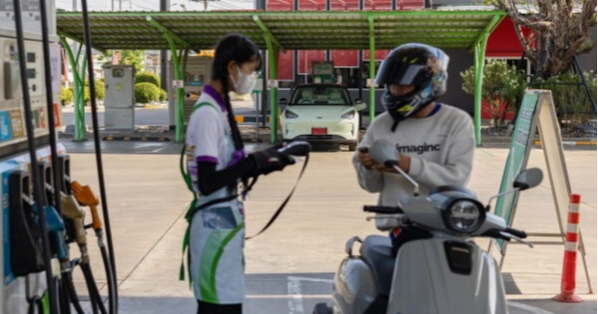
Rising global fuel prices, driven in part by disruptions in the Middle East, have accelerated demand for electric vehicles (EVs) worldwide, giving Chinese automakers a stronger foothold in developing markets even as charging infrastructure struggles to keep pace.
The blockade of the Strait of Hormuz, a key global energy route, disrupted the shipment of around one-fifth of the world’s crude oil and liquefied natural gas, first affecting Asia and later spreading to Africa. The shock pushed fuel prices higher and strengthened the shift toward electric mobility.
As a result, global exports of Chinese EVs jumped sharply. In April alone, shipments reached a record $9.4 billion, according to analysis of Chinese customs data by the think tank Ember. Exports surged to countries including Australia, Brazil, Southeast Asia and East Africa.
China exported about 435,000 passenger EVs and plug-in hybrids in May, more than double the same period last year, according to the China Association of Automobile Manufacturers.
Governments from Laos to Ethiopia are also promoting electrification to reduce fuel import costs and subsidies, while consumers increasingly turn to EVs to cope with rising transport expenses.
However, the rapid expansion in EV adoption is exposing a major weakness: underdeveloped charging networks.
Experts say the mismatch between rising EV numbers and limited charging points has created a “chicken-and-egg problem.” Paul Gong, head of China automotive research at UBS, said government support is crucial to overcome the gap.
“Government support for infrastructure could help accelerate adoption,” he said.
Rising EV demand across Asia and Africa
In Southeast Asia, imports of Chinese EVs have surged, particularly in Thailand, Laos and the Philippines. Laos recently announced a ban on fuel-powered vehicle imports for the rest of 2026 as part of its shift toward electric transport.
Africa imported about 44,000 Chinese EVs in 2025, a 130% increase from a year earlier, according to Chinese trade data.
Transport costs account for a large share of household spending across many developing countries, making consumers highly sensitive to fuel price volatility. In South Africa, transport makes up nearly one-fifth of household expenses, according to a 2024 Stellenbosch University study.
Global EV adoption is also rising rapidly. One in four new cars sold worldwide last year was electric, according to the International Energy Agency (IEA), which projects sales could reach 23 million in 2026, or nearly 30% of global car sales.
Chinese automakers currently supply around 60% of global EV sales, the IEA said, with growing expansion into Europe, Africa and Latin America.
“In the next five years, we will accelerate our overseas expansion,” said Jerry Gan, CEO of Geely Auto, at a company event in March.
In Vietnam, domestic EV maker VinFast has also seen strong growth, supported by rising demand in Southeast Asia. One rider in Hanoi said switching to an electric motorbike has significantly reduced his fuel expenses.
“Before, so much of my income went into fuel. Now, I can actually save some money,” he said.
Charging infrastructure falling behind
Despite strong sales growth, charging infrastructure remains limited in many countries.
Thailand, for example, has about 4,600 public charging locations serving more than 424,000 EVs and plug-in hybrids, according to the Electric Vehicle Association of Thailand. That is roughly one charging location for every 92 vehicles.
Some drivers say the shortage creates daily challenges. Others continue to rely on hybrid solutions, keeping fuel-powered vehicles for longer trips.
In Malaysia, public fast-charging stations increased by more than 70% in 2025 after government incentives. Indonesia has also expanded its network to more than 4,500 charging stations through its state utility PLN.
But in contrast, Ethiopia, which has banned imports of non-electric vehicles, had only around a dozen charging stations as of mid-2025, despite estimating a need for more than 1,170.
“In developing markets, affordability can accelerate the shift, but infrastructure, power reliability and usage patterns remain key constraints,” said Chris Liu of research firm Omdia.
Governments and utilities step in
Across Africa and parts of Asia, state-owned utilities are increasingly taking the lead in building EV charging infrastructure.
Experts say utilities see EVs as a future source of electricity demand and are positioning themselves accordingly. Kenya Power, for example, plans to build 44 charging stations in the coming year.
Africa currently has about 2,000 public charging stations, with South Africa accounting for the largest share.
However, challenges remain, including grid capacity, maintenance and investment costs.
Analysts say large automakers have limited incentive to build charging networks abroad, making government-backed utilities a key driver of future expansion.
“You need charging infrastructure to support an even larger fleet size,” said UBS analyst Paul Gong.