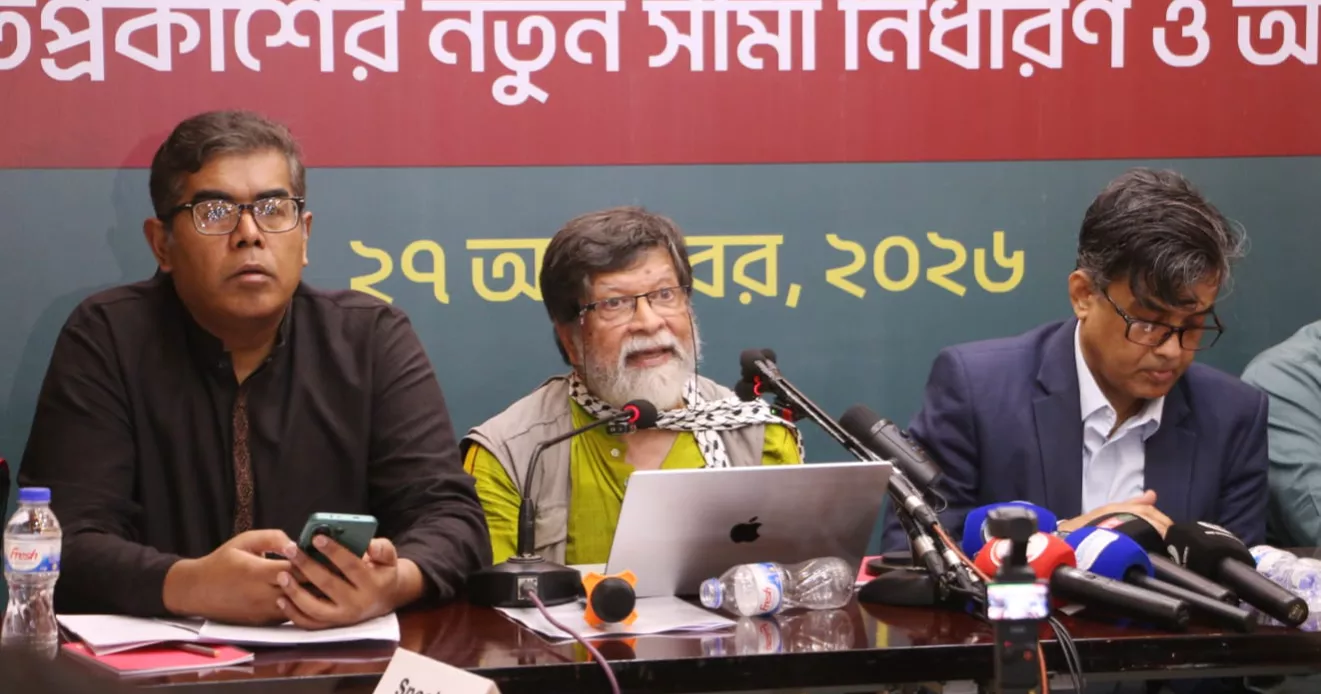
Speakers at a citizens' dialogue on Tuesday warned that the proposed amendments to the Cyber Security Act 2026 risk curtailing freedom of expression and civic freedoms, cautioning that the legislation could be repurposed to target dissenting voices.
The dialogue, titled “Cyber Security or Suppression of Voices? In Whose Interest is the New Boundary of Freedom of Expression and Law Amendment Being Set?”, was held at the BDBL Building in Kawran Bazar, Dhaka.
The event was jointly organized by seven human rights and advocacy organizations: Voice for Reform, Drik, Nagorik Coalition, HRSS, JRA, DSA Victim Alliance, and the Bangladesh America Alliance. Renowned photographer and human rights activist Shahidul Alam presided over the session, while Fahim Mashroor, co-convener of Voice for Reform, moderated the discussion.
Prominent participants included National Citizen Party (NCP) Member of Parliament Akhter Hossen, former UN Enforced Disappearances Inquiry Commission member Dr. Nabila Idris, Wada Editor Shafiqul Alam, former Media Reform Commission head Kamal Ahmed, former Special Assistant to the Chief Adviser Monir Haider, Alternative organizer Dr. Taznuva Zabeen, State Reform Movement's Didar Bhuiyan, Sarwar Tushar of NCP, Nagorik Coalition’s Hasib Hossain, and HRSS Executive Director Ejaz Islam.
Presenting the keynote concept paper, Fahim Mashroor noted that while the original intent of cyber legislation was to protect citizens and businesses from hacking, phishing, and financial fraud, the proposed amendments risk transforming the legal framework into an instrument for criminalizing dissent, much like the previous digital security regime. He suggested decoupling provisions concerning women and children's safety from the cyber law and integrating them under the Women and Children Repression Prevention Act.
MP Akhter Hossen remarked that the proposed amendments effectively turn the cyber security framework into a "government protection law" rather than a safeguard for ordinary citizens.
Former Special Assistant to the Chief Adviser Monir Haider expressed deep concern over the shrinking space for freedom of speech, warning that the administration is treading dangerously close to authoritarian thresholds. He observed that while past regimes took years to suppress public voices, the current administration is accelerating along a restrictive trajectory, adding that referendums or broader public accountability mechanisms could help address growing governance deficits.
Dr. Nabila Idris pointed out that a significant proportion of arrests under the cyber law since February's elections stemmed from criticisms directed at high-ranking officials and national leaders, arguing that such actions lack legal justification and reflect patterns of unwarranted harassment.
Former Media Reform Commission head Kamal Ahmed noted that while the government consulted select mainstream media forums on the draft amendments, freedom of expression and protection must extend universally to all citizens rather than being confined solely to institutional media.
Concluding the dialogue, chairperson Shahidul Alam emphasized that the ultimate ownership of the state rests with its citizens, urging the administration to heed public demands and preserve fundamental democratic freedoms. Participants reached a broad consensus that while combating cybercrime is necessary, enforcement must never conflict with constitutionally guaranteed freedoms of expression, and must feature transparent definitions, accountability, and multi-stakeholder consultations.