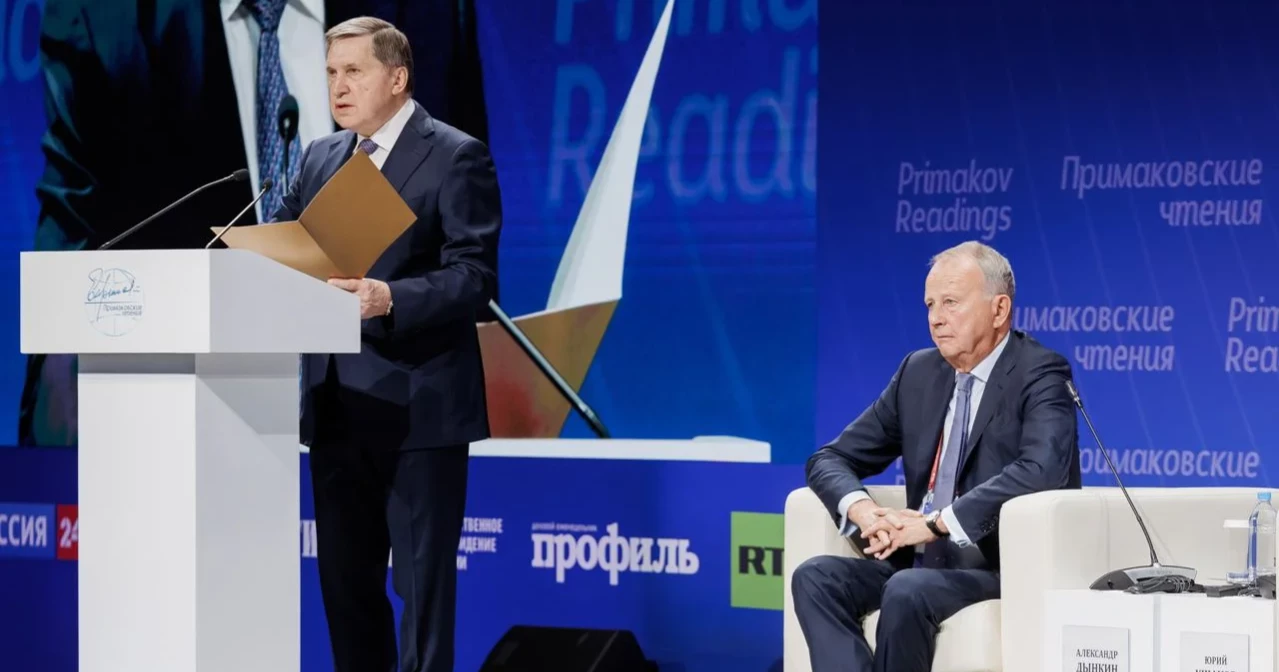
The two-day 12th international forum "Primakov Readings" began on Tuesday in Moscow, coinciding with the 70th anniversary of IMEMO.
The theme of the forum is “A World Without Rules: A Power Game?”
More than 400 leading international experts in the field of security, world politics and economy from 17 countries, including China, India, Iran, Turkey, Bulgaria, Qatar, the US, the UK, Switzerland, South Korea, Brazil, Azerbaijan, Armenia, Georgia, Kyrgyzstan, Uzbekistan and Russia, are attending the event.
The programme of the Forum is centred around the discussions on the consequences of regional conflicts, the situation in the Middle East, global order scenarios, and barriers to global trade and investment, international competition in the sphere of artificial intelligence.
The participants are discussing the issues of Eurasian security in light of Russia’s CSTO chairmanship, the consequences of the New START Treaty termination, the risks of a further weakening of arms control, the impact of emerging military technologies on strategic stability, and the prospects for preventing conflict escalation in the context of an accelerating arms race.
During the two-day event, five working sessions are planned, as well as the traditional speech by the Russian Foreign Minister Sergey Lavrov scheduled on June 24.
The participants of the Forum were addressed with a welcoming speech by the Aide to the President of the Russian Federation, Chairman of the "Primakov Readings" Organising Committee Yuri Ushakov, Deputy Speaker of the Federation Council of the Federal Assembly of the Russian Federation Konstantin Kosachev, and the President of Primakov Institute of World Economy and International Relations of the Russian Academy of Sciences (IMEMO) Alexander Dynkin.
“The history of the last 200-plus years shows that every new world order is shaped by the winners of another major war. This was the case after the Napoleonic Wars, the First World War, and the Second World War. It was also the case after the Cold War, when a unipolar world emerged. The dramatic and structural break with the past is the presence of nuclear weapons. Therefore, the existential challenge today is to shape the contours of the future world order without passing the point of no return,” noted Alexander Dynkin.