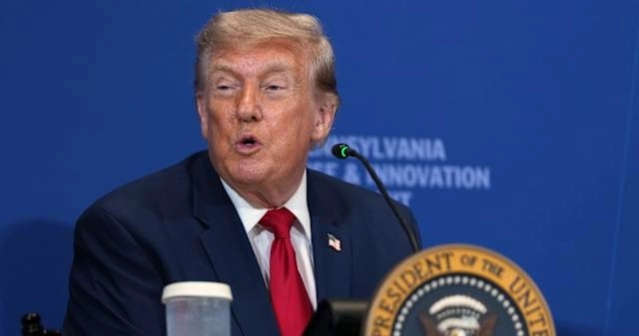
US President Donald Trump is expected to revisit his long-standing claims about the 2020 presidential election during a primetime address from the White House on Thursday, despite years of official findings that the election was secure, legitimate and free of widespread fraud.
Following Trump's 2020 election defeat to Joe Biden, officials appointed by Trump to lead the Justice Department, intelligence agencies and cybersecurity bodies consistently concluded that there was no evidence of major fraud or foreign interference that could have changed the election outcome.
Since returning to office for a second term, Trump has sought to challenge those conclusions. He has appointed senior officials who support his claims that the 2020 election was stolen and has made clear that he expects his administration to align with that position.
The issue has become a key loyalty test for many of Trump's nominees. During his Senate confirmation hearing on Wednesday, Jay Clayton, Trump's nominee for national intelligence director, avoided directly saying Biden won the election.
"He had the most electoral votes," Clayton said. "He was declared the winner."
When Democratic Senator Mark Kelly pressed him on whether the person with the most electoral votes is the winner, Clayton declined to answer directly.
Trump has repeatedly promoted conspiracy theories alleging that an international network manipulated US voting machines in 2020, claims that have been rejected by courts and election officials and have triggered several high-profile defamation lawsuits.
Ahead of Thursday's address, Trump promised to reveal "really big news," saying that "without free and fair elections, you don't have a country."
Election experts, however, fear the speech could revive false claims that have already been extensively investigated.
"There have been more than six years of consistent findings from intelligence agencies and election experts showing there was no foreign interference in the 2020 election and that US voting systems were secure," said Victoria Bassetti of States United, a nonpartisan organisation that supports state election officials. She said any new claims without evidence would contradict years of documented findings.
Years of reviews found no widespread fraud
Numerous court rulings, audits, recounts and investigations — including several conducted by Republican officials — found no evidence of widespread fraud or significant problems with the 2020 election.
Trump and his allies lost dozens of legal challenges seeking to overturn the election results, including cases heard by judges appointed by Trump himself.
Former Attorney General William Barr, who served under Trump, said there was no evidence of significant election fraud, a conclusion that drew Trump's criticism.
Chris Krebs, the former head of the federal cybersecurity agency responsible for protecting election infrastructure, also declared the 2020 election secure and said there was no evidence of vote tampering. Trump dismissed Krebs shortly afterward and later ordered an investigation into him after returning to office in 2025.
An intelligence assessment completed on Jan. 7, 2021, during Trump's final days of his first term, also found no evidence that foreign actors altered vote totals or election equipment.
In addition, Trump signed a federal review document last year stating that there was no evidence any foreign government had altered vote counting or the outcome of any US election.
Fresh federal review underway
After returning to office, Trump ordered a new federal review of the 2020 election.
Federal investigators have seized voting records from Fulton County, Georgia, and Maricopa County, Arizona — two key counties that featured prominently in post-election conspiracy theories.
Trump appointed attorney Kurt Olsen to lead the investigation. Olsen has been associated with election fraud claims and was previously sanctioned by the Arizona Supreme Court for making false statements in a lawsuit challenging the 2022 Arizona governor's race.
David Becker, a former Justice Department lawyer who now heads the Center for Election Integrity & Research, criticised the renewed investigation.
"He has committed untold taxpayer resources," Becker said. "They've found nothing."
According to Becker, search warrant documents filed in the Fulton County investigation repeated conspiracy theories that had already been disproved, while the FBI reassigned hundreds of analysts to review the material.
Conspiracy theories fuel costly lawsuits
Despite repeated official findings, supporters of election conspiracy theories continue to claim that Trump will eventually present conclusive evidence of widespread fraud.
One widely circulated theory alleges that Venezuela and other countries manipulated US voting machines to prevent Trump's victory.
Those allegations have led to major defamation lawsuits against media organisations and individuals.
Fox News agreed to pay $787.5 million to settle a lawsuit over broadcasting false claims about voting machines after the 2020 election. Newsmax and One America News have also reached settlements with voting technology companies over similar allegations.
Separately, a Denver jury found Mike Lindell, a leading promoter of election conspiracy theories whom Trump recently endorsed for governor of Minnesota, liable for defaming an employee of a voting machine company by calling him a traitor.
Becker said the pattern over the past six years has remained consistent: broad public allegations have repeatedly failed when tested in court because they lacked supporting evidence.
"If someone's alleging a crime that occurred six years ago, we shouldn't simply respond to the claims," Becker said. "We should require evidence that proves them."