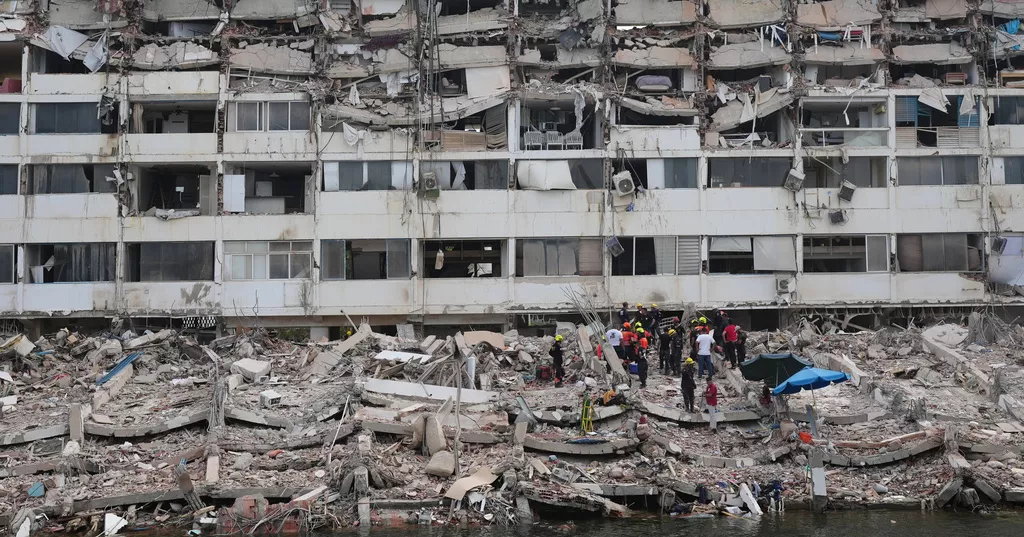
Rescuers in northern Venezuela continued searching through collapsed buildings on Monday for survivors of last week's twin earthquakes as a 4.6-magnitude aftershock struck the disaster-hit state of La Guaira, adding to fears in the devastated region.
With five days having passed since the powerful earthquakes, hopes of finding more survivors are fading. Relief agencies say the first 72 hours after a natural disaster are the most critical for rescue efforts, although survival is possible for longer if victims have access to food and water.
The official death toll has risen to more than 1,700.
Attention is now increasingly focused on the growing humanitarian crisis and whether the cash-strapped government led by acting President Delcy Rodríguez can effectively support thousands of people left homeless. Rodríguez took office in January after the Trump administration removed former President Nicolás Maduro from power.
Amid criticism that the government's response has been too slow, state media has highlighted rescue efforts, including footage of Rodríguez visiting a shelter in the badly affected town of Catia La Mar and survivors being pulled from the rubble.
However, such scenes remain uncommon in the hardest-hit areas, where families continue waiting for news of missing relatives.
"We have to stay strong, even without food, without sleep," said Ana Rada as rescue workers searched for her brother. "Until I see the body, I still have hope."
Aftershock sparks fresh panic
Monday's aftershock struck about 27 kilometers (17 miles) north of Caraballeda on Venezuela's Caribbean coast. The United States Geological Survey measured it at magnitude 4.6, while Colombia's geological survey estimated it at 5.1.
National Assembly leader Jorge Rodríguez said there were no immediate reports of additional damage. Still, the tremor sent frightened residents rushing into the streets in Caracas.
"Here we are again, back in the street. I don't know when we'll have a moment of true peace," said Concepción Hernández, a resident of Caracas.
The Caracas Metro temporarily suspended operations to inspect infrastructure following the aftershock.
US expands disaster assistance
The disaster has also increased attention on the Trump administration, which assumed control of Venezuela's oil industry earlier this year.
A senior US State Department official said about 300 American first responders are working alongside international rescue teams. Around two dozen C-17 military transport aircraft are delivering relief supplies daily, while total US assistance has exceeded $300 million.
The US military is also helping repair damage at La Guaira port to facilitate the arrival of aid shipments and assisting with air traffic management after part of the control tower at Simón Bolívar International Airport was damaged in the earthquakes.
However, the administration is not expected to grant temporary legal protections to Venezuelans already living in the United States, despite similar measures being adopted after major earthquakes in Haiti in 2010 and El Salvador in 2001.
The Trump administration has intensified immigration enforcement against Venezuelans, revoking temporary legal protections for hundreds of thousands and increasing deportation flights.
Deported migrant joins rescue efforts
Among those helping search through the rubble in La Guaira is miner Jean Sosa, who said he was deported from the United States in January after missing an immigration court hearing.
Sosa said he returned to Caracas last month after a difficult journey through several countries and has since rescued 20 people alive while volunteering in the disaster zone.
"I'm not involved in politics, but I believe many people could have been saved if there had been equipment and support from top authorities from the very beginning," he told AP.
He said rescue teams continue to face shortages of basic equipment, forcing volunteers to work without gloves and improvise with limited supplies.
Conflicting estimates of disaster's impact
Authorities and international agencies continue to offer sharply different estimates of the scale of destruction.
Jorge Rodríguez said 15,866 people had been affected and 855 buildings had been damaged or destroyed.
However, a preliminary assessment by NASA estimated that nearly 58,870 buildings were damaged or destroyed based on radar imagery from the European Space Agency's Sentinel-1 satellites.
The United Nations estimates that up to 6.8 million of Venezuela's nearly 30 million people could be affected through displacement or disruption of essential services such as electricity and water.
With communication networks badly affected, many Venezuelans have turned to online databases operated by non-governmental groups to report missing relatives. One such database has received reports of more than 50,000 missing people, although it remains unclear how many have since been found.