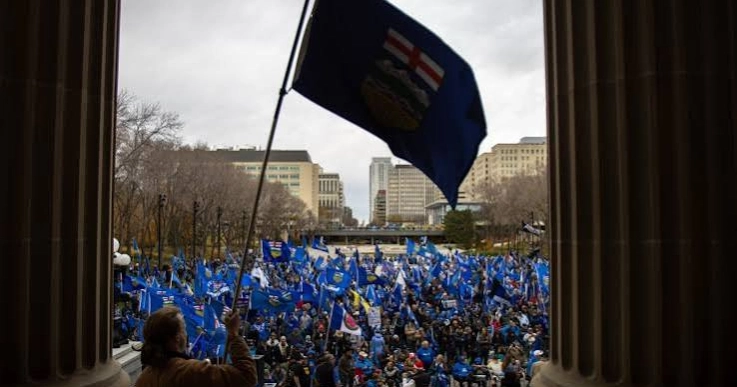
Voters in Canada's oil-rich Alberta province have overwhelmingly backed remaining part of the country, dealing a setback to the separatist movement and a boost to Prime Minister Mark Carney's efforts to strengthen national unity amid US President Donald Trump's trade war and threats to annex Canada.
With more than 1.4 million ballots counted, around 76 percent of voters supported staying in Canada, while nearly 24 percent backed initiating a process toward separation, according to unofficial results from Elections Alberta.
The referendum did not directly ask voters to declare independence. Instead, approval would have paved the way for a future vote on whether Alberta should leave Canada.
Reacting to the results, Carney said Albertans had made a clear choice in favour of unity and cooperation.
He said the outcome would help Canadians move forward together, diversify trade, accelerate major infrastructure projects and strengthen Canada's position as a global energy powerhouse, with Alberta playing a central role.
Separatist leaders, however, argued that the result demonstrated significant support for their cause.
Keith Wilson, a prominent figure in the independence movement, said at least a quarter of Albertans believed the province deserved better treatment from the federal government, although the final vote count was yet to be confirmed.
Alberta Premier Danielle Smith also welcomed the early results, saying voters had chosen a stronger province within a united Canada.
Smith, who called the referendum amid pressure from separatists within her governing United Conservative Party (UCP) despite opposing independence, was expected to address the province later Tuesday on the outcome and Alberta's future.
Thomas Lukaszuk, a former deputy premier who led the campaign against separation under the banner Forever Canadian, said the results demonstrated that Canada remained united from coast to coast.
The announcement of results was delayed after the late opening of polling stations forced more than 100 voting centres to extend their hours on Monday.
Alberta, which holds the world's fourth-largest proven oil reserves, is a conservative stronghold with a political culture often associated more closely with the American West than other parts of Canada. Although resentment toward the federal government in Ottawa has long been strong, it has not traditionally translated into widespread support for independence.
Despite the apparent defeat, separatist leaders said their campaign had evolved from a fringe cause into a movement that would continue to influence provincial politics.
Carney had earlier urged Albertans to deliver a decisive vote for unity during a rally in Edmonton on Friday, the city where he grew up.
Former Alberta premier Jason Kenney said separatist parties had traditionally secured only one to two percent of the vote. Anger over COVID-19 restrictions later helped mobilise activists who joined the independence movement, he said.
Trump's trade war and threats to make Canada the 51st US state have also helped Carney rally support in Alberta, where Liberal prime ministers have historically faced opposition.
At a gathering of separatist supporters in an Edmonton restaurant, attendees fell silent as the results came in.
Jeff Rath of the Alberta Prosperity Project said the movement would continue its campaign, arguing that it had dominated public discussion over the past year and educated voters about the potential benefits of independence.
Rath had previously said he would consider it a strong result if 30 percent of voters supported beginning the separation process. He also called for Smith to be removed as UCP leader, suggesting the party could split and potentially give rise to a new pro-independence party.
Some voters who supported separation said Alberta had long been treated unfairly by the federal government.
Dustin Degenhardt, who voted in Wainwright on Monday, described the province as being treated like a colony, arguing that Ottawa took resources from Alberta without providing sufficient returns.
Others questioned the timing and cost of the referendum.
Dave Malka, 59, of Edmonton, criticised spending public money on a vote that would only determine whether another referendum should be held, saying the funds could have been directed toward healthcare.
With Trump threatening Canada, Malka said the country should be strengthening national unity rather than becoming divided internally.