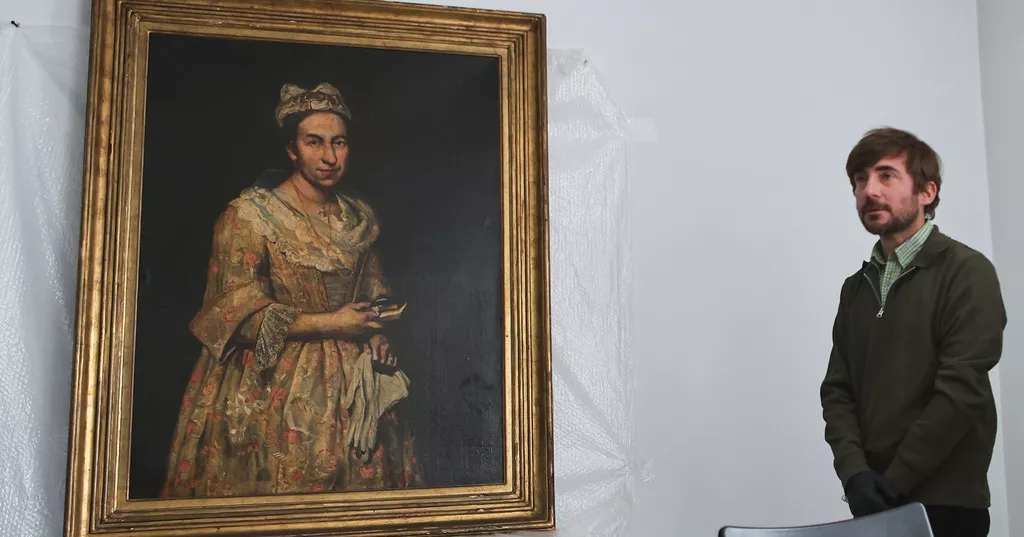
An Argentine court on Friday approved an agreement clearing the way for the return of an 18th-century portrait looted from a prominent Jewish art dealer during World War II to his surviving heir.
The agreement allows Patricia Kadgien, daughter of a former senior Nazi official, and her husband, Juan Carlos Cortegoso, to give up their claim to the painting in exchange for avoiding a criminal trial and remaining under court supervision for two years.
The work, known as “Portrait of a Lady,” will be returned to Marei von Saher, the sole surviving heir of Dutch-Jewish art dealer Jacques Goudstikker.
Goudstikker's extensive art collection was forcibly sold to Nazi officials after Germany invaded the Netherlands in 1940. The couple had been charged with aggravated cover-up last year after authorities alleged they concealed the painting despite knowing that investigators were searching for it.
Under the court-approved deal, the couple must remain under judicial supervision for two years, make payments to a hospital in Mar del Plata, where they live, and regularly report their whereabouts to authorities.
The painting was rediscovered after Dutch journalists investigating Friedrich Kadgien, a former Nazi financial official who fled to Argentina after the war, spotted it in an online property listing for his daughter's home in Mar del Plata in August 2025.
The listing was removed shortly after a Dutch newspaper published the discovery. Argentine police searched the property several times without finding the artwork before Kadgien's lawyer eventually handed it over to authorities.
The portrait had long been attributed to Italian Baroque painter Giuseppe Vittore Ghislandi. However, an examination ordered by the court and conducted by Argentina's National Academy of Fine Arts attributed it to Italian painter Giacomo Antonio Melchiorre Ceruti.
Experts confirmed that the painting had belonged to Goudstikker's collection and estimated its value at about 250,000 euros ($290,000).
Goudstikker was among Europe's leading art dealers before World War II and owned works by renowned painters including Rembrandt and Vermeer. He died in a shipwreck while fleeing the Netherlands with his family as German forces invaded in May 1940.
About 1,100 works from his collection were illegally sold to Hermann Göring, one of Adolf Hitler's most powerful associates and a major collector of looted art.
It remains unclear how the portrait later came into the possession of Friedrich Kadgien, who served as Göring's financial adviser and was involved in handling foreign currency, precious metals and confiscated property for the Nazi regime.
Kadgien escaped Europe after the war, eventually settling in Argentina, where he died in 1978 without being arrested or prosecuted for war crimes.
Von Saher, who lives in Greenwich, Connecticut, has spent decades seeking the return of artworks stolen from her family. Her lawyers said she has agreed to have the portrait exhibited in Argentina before it is returned to her.
Argentine authorities also recovered two 19th-century paintings, along with prints and engravings, during searches last year of properties belonging to Kadgien and her sister in Mar del Plata. Investigators are examining whether any of those works were also looted during World War II.