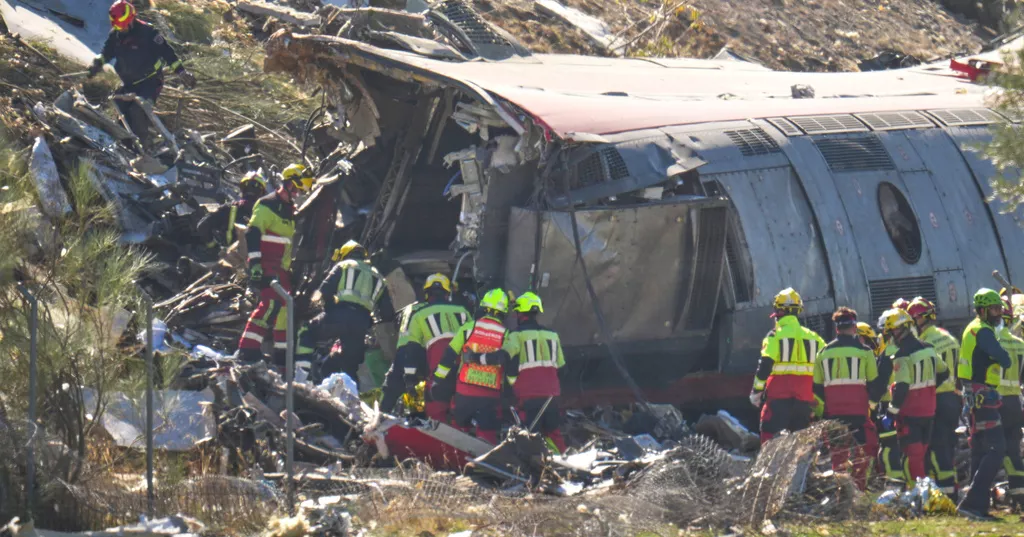
At least 68 people were killed and 58 others required hospital treatment after two high-speed trains collided in central Spain on Wednesday, prompting a major rescue operation at the scene, regional authorities said.
The regional government of Castilla-La Mancha confirmed the death toll, while rescue workers continued searching the wreckage for survivors and bodies.
The crash occurred in the province of Toledo when a state-owned RENFE train struck the rear of a stationary train operated by private company IRYO, knocking two carriages off the tracks. Both trains were carrying hundreds of passengers and travelling in the same direction from Madrid towards Seville in southwestern Spain, according to rail operator ADIF.
The accident has renewed concerns over rail safety following another deadly collision involving high-speed trains in southern Spain in January.
David Gómez, a construction worker who was working nearby with his brother and a colleague, told the newspaper El País that they rushed to help after hearing the crash.
“People were trying to get out through the windows,” he said, describing how they cut through fences to reach the wreckage and provided first aid until emergency services arrived.
He also recalled seeing a severely injured young woman as he tried to pull her out of the wreckage.
Esther Padilla, a spokesperson for the Castilla-La Mancha regional government, said the cause of the collision remained unknown. Rail services between Madrid, Ciudad Real and Andalusia were suspended.
The crash occurred on a flat stretch of track surrounded by olive groves between the towns of Urda and Los Yébenes. One carriage was torn apart, scattering debris down a gravel slope.
Spanish Health Minister Mónica García said rescue teams were concentrating on recovering survivors and bodies from the two most severely damaged carriages. The injured were being taken to hospitals in the surrounding area.
“Because it was a high-speed impact, we are expecting this to be a tragedy,” García said.
Passenger Ignacio Relaño, who was aboard the RENFE train, told state broadcaster TVE that the train had briefly stopped before moving again and colliding with the IRYO train.
“We all felt the train abruptly slowing down and then the impact,” he said, adding that the carriage tilted to one side and passengers' belongings, including luggage and mobile phones, flew around.
Another passenger told Cadena Ser radio that she was thrown forward when the train braked sharply, breaking the small table in front of her. She said she saw body parts and bloodied passengers trapped in the wreckage.
Padilla said 397 passengers were aboard the RENFE train and 147 on the IRYO train. Trains operated by the two companies were also involved in the deadly January crash.
IRYO, an Italian-owned company, said it had activated its safety protocols and was cooperating closely with the authorities.
Manuel Galán, mayor of nearby Urda, said civil protection officials had asked the local administration to prepare a sports pavilion to accommodate injured passengers.
A military emergency brigade joined firefighters, police and other emergency teams at the scene. Ambulances and medical helicopters transported the injured, while uninjured passengers were taken away by bus.
Prime Minister Pedro Sánchez cancelled his scheduled engagements to focus on the disaster. In a post on X, he said he was deeply distressed by the crash and that emergency services were working to assist affected passengers.
King Felipe VI and Queen Letizia also expressed their sorrow, extending condolences to the victims' families and support to the injured and others affected.
European Commission President Ursula von der Leyen said her thoughts were with the victims' families, adding that Europe was mourning with Spain.
Spain's national soccer federation also postponed all 24 Copa del Rey matches scheduled for Wednesday following the accident.
Before this year, Spain had not experienced a fatal accident on its dedicated high-speed rail lines since the network opened in 1992.