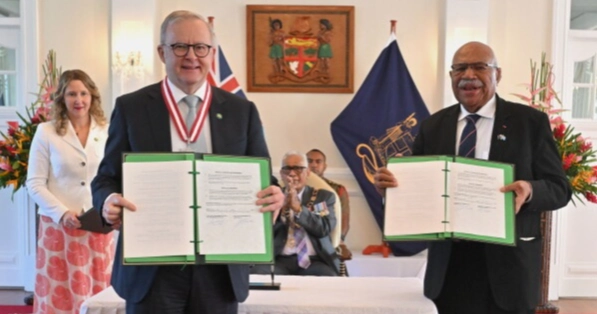
Australia and Fiji on Monday signed a new mutual defence agreement, marking another major step by Australian Prime Minister Anthony Albanese to strengthen ties in the South Pacific as Canberra seeks to counter China's growing influence in the region.
Later on Monday, Chinese state media reported that China had test-fired a long-range ballistic missile from a submarine in the South Pacific. Australia criticised the missile test, calling it destabilising.
Albanese and Fijian Prime Minister Sitiveni Rabuka signed the Ocean of Peace Alliance in Fiji's capital, Suva. The two leaders also signed the Vuvale Union, an economic agreement under which Australia will invest more than 1 billion Australian dollars (about $693 million) in Fiji over the next 10 years.
The Ocean of Peace Alliance is Fiji's first mutual defence treaty. For Australia, it is its fourth such agreement after long-standing defence treaties with the United States and New Zealand signed in 1951, and a bilateral defence pact with Papua New Guinea signed last year.
"The Ocean of Peace Alliance introduces a mutual defence obligation, and there's no higher obligation than to come to each other's aid at a time of need," Albanese told reporters.
Rabuka said he did not expect Beijing to react negatively to the new agreements.
"I do not expect China to have any severe pushback on either government. I believe they will welcome the understanding between Australia and Fiji," he said.
He added that the agreements would not affect Fiji's ties with China or Australia's relationship with Beijing.
According to China's state-run Xinhua News Agency, the missile test was part of routine military training and carried a dummy warhead. China last carried out a similar missile test in the Pacific two years ago, when it launched an intercontinental ballistic missile with a dummy warhead.
Australian Foreign Minister Penny Wong, who attended the signing ceremony in Fiji, declined to speculate whether the missile launch was intended as a response to the new defence pact.
"I'll leave China to speak to its intent," Wong said.
She said China had informed Australia in advance about the missile test.
"Australia has been clear with China that we regard this as destabilising to the region," Wong said.
She added that the test came at a time when China is rapidly expanding its military capabilities without providing the level of transparency and reassurance expected by countries in the region.
In Beijing, Chinese Foreign Ministry spokesperson Mao Ning described the launch as a routine military exercise and said it was not aimed at any particular country.
"We hope that the relevant countries will avoid overinterpretation," Mao said.
Commenting on the Australia-Fiji defence agreement, Mao said China's cooperation with Pacific island nations is based on mutual respect and equality and is not intended to serve political interests.
She urged other countries to respect the independence of Pacific island nations, support their sustainable development and avoid actions that could harm the interests of third parties.
Australia has been working to strengthen its position as the preferred security partner in the Pacific since China signed a secret security agreement with the Solomon Islands in 2022. That deal raised concerns in Canberra and its allies over the possibility of a Chinese naval base being established in the South Pacific.
Albanese is scheduled to visit the Solomon Islands on Tuesday for talks with Prime Minister Matthew Wale after the two countries agreed to hold further discussions on a security agreement.
Wale said during a visit to Australia last month that his government would review the Solomon Islands' security deal with China.
On Wednesday, Albanese will host Papua New Guinea Prime Minister James Marape and Tongan Prime Minister Fatafehi Fakafānua in Brisbane.
Australia's defence treaty with neighbouring Papua New Guinea is set to take effect on Wednesday.
Last week, Australia and Vanuatu also signed the long-awaited Nakamal Agreement, covering security and economic cooperation. The deal is designed to prevent China from establishing a military base in Vanuatu.
Albanese signed the agreement with Vanuatu Prime Minister Jotham Napat in Canberra, nine months after Vanuatu rejected an earlier draft over concerns it could limit the country's ability to attract infrastructure investment.
China last week expressed concern that the Nakamal Agreement could be aimed at Beijing.