California’s election of Xavier Becerra as its fifth consecutive Catholic governor highlights the enduring influence of Catholicism in the state, where religious identity and progressive politics often coexist.
Becerra, a Democrat and former US health and human services secretary, has spoken about how his Catholic upbringing shapes his political views, including his belief in the sanctity of life while supporting abortion rights.
His position reflects the complex relationship between Catholic beliefs and political choices, illustrating how American Catholics do not necessarily follow a single political direction.
“There is no Catholic vote,” said David Gibson, director of Fordham University's Center on Religion and Culture, noting that Catholics are less politically predictable than groups such as white evangelical Republicans or Black Protestant Democrats.
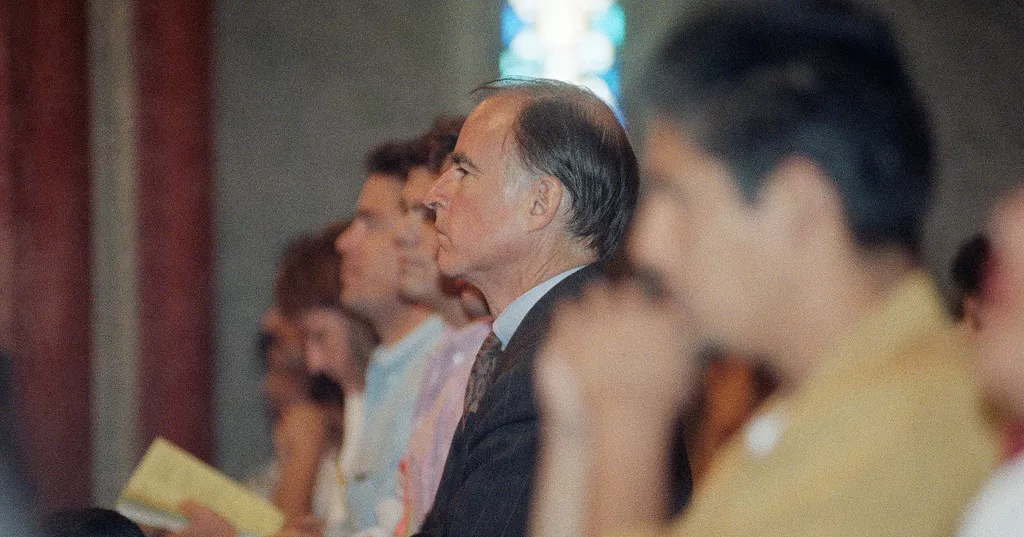
With Becerra's victory this week, California has elected five consecutive Catholic governors, beginning with Gray Davis, who took office in 1999. Four of the five have been Democrats. Former Governor Jerry Brown was particularly outspoken about his faith, having studied at a seminary in the 1950s.
California has more Catholics than any other US state. According to a 2024 Pew Research Center survey, 25 percent of the state's adults identify as Catholic, representing nearly half of its Christian population.
Beyond the numbers, Catholicism has been deeply embedded in California's history and culture for centuries.
Catholics reflect diverse political views
Catholic teachings encompass a wide range of positions, including economic progressivism, opposition to the death penalty and official opposition to abortion and in vitro fertilisation. This combination often makes it difficult to place Catholic voters within conventional political categories.
Governor Gavin Newsom, for instance, strongly supports abortion rights, a position that conflicts with the Catholic Church's leadership. However, the California Catholic Conference welcomed his announcement this week that he planned to commute more than 500 death sentences to life imprisonment without the possibility of parole.
In a public letter, Newsom said he took the decision because state-sanctioned executions were incompatible with California's values, weakened the foundations of the legal system and diminished society as a whole.
Church leaders have also taken differing positions on political issues. San Bernardino Bishop Alberto Rojas last year formally excused parishioners from their weekly obligation to attend Mass after immigration detentions took place on church properties in his diocese, challenging policies of the Trump administration.
On the other hand, San Francisco Archbishop Salvatore Cordileone took a conservative position in 2022 by barring US Representative Nancy Pelosi, herself a Catholic, from receiving Communion because of her support for abortion rights.
According to The AP Voter Poll, around two in 10 voters in California's gubernatorial election were Catholic, and most of them supported Becerra. Approximately six in 10 Catholic voters backed him, while four in 10 voted for his Republican rival, Steve Hilton.
Among Latino Catholics, around seven in 10 voted for Becerra, while white Catholic voters were almost evenly divided between the two candidates.
Similar political divisions exist among Catholics nationwide, who were split evenly between Democrats and Republicans. This marked a modest shift from the 2024 election, when slightly more than half of US Catholic voters supported Donald Trump, according to AP VoteCast.
California Catholics come from diverse backgrounds
The Catholic community in California is also ethnically diverse, with many members tracing their roots to Latin America and the Philippines. Others, including resident Tracy Creighton, have family histories dating back to the missions established more than two centuries ago by Spanish Franciscan priests.
Creighton, a mother of teenagers, said she tries to pass on the importance of serving others and respecting nature, values she considers central to both Catholicism and California's identity.
She expressed concern that society had lost its sense of service to others in recent years and cited Saint Francis of Assisi as an example of the values that keep her connected to the Catholic Church.
Catholic faith, history and culture have shaped how many Californians understand their identity, including their relationship with the 21 missions established between 1769 and 1823.
Cecilia González-Andrieu, a theology professor at Loyola Marymount University, said the legacy of the missions was complicated and carried problematic implications.
She said Latina theologians needed to acknowledge the coexistence of different cultural and ancestral influences within their identities.
The state's education system is also addressing this complex history. The missions are included in the statewide fourth-grade curriculum, which often involves visits to one of the historic sites.
A law signed by Newsom and effective from last year requires schools to teach students in social studies classes about the mistreatment of Native Americans by missionaries and include Indigenous perspectives.
Historians say the consequences of the mission system extended beyond mistreatment. William Deverell, a historian at the University of Southern California, said the missions spread diseases and were unable to address their effects on Indigenous communities, contributing to a severe decline in the Native population.
Catholic influence extends beyond religion
Despite their complicated history, the missions remain important landmarks, with many continuing to operate as Catholic parishes.
They also influenced the Spanish Colonial Revival architectural style that became a distinctive feature of California homes.
Creighton said California's architecture and beauty were among the reasons she loved the state, adding that Catholicism had played a significant role in shaping its architectural identity.
She described Mission San Luis Rey in Oceanside, near San Diego, as particularly important to the local community, saying people regularly visit the site for homecoming and Christmas photographs, including those who are not Catholic.
She said the mission had become an integral landmark in defining the community's identity.
Catholic influence is also visible in many California households through religious symbols and traditions.
Brian Murillo, a state employee whose father is from Mexico, has kept crucifixes and votive candles in his Fresno home despite describing himself as a lapsed Catholic.
He stopped attending Mass because he felt the leadership of the American Catholic Church had become too closely aligned with Republican politics. However, he continues to say Hail Mary or Our Father prayers whenever he leaves home.
Murillo said Catholicism had been such an important part of his upbringing that he still practised some of its traditions in his daily life, sometimes praying while cleaning his house or driving alone.