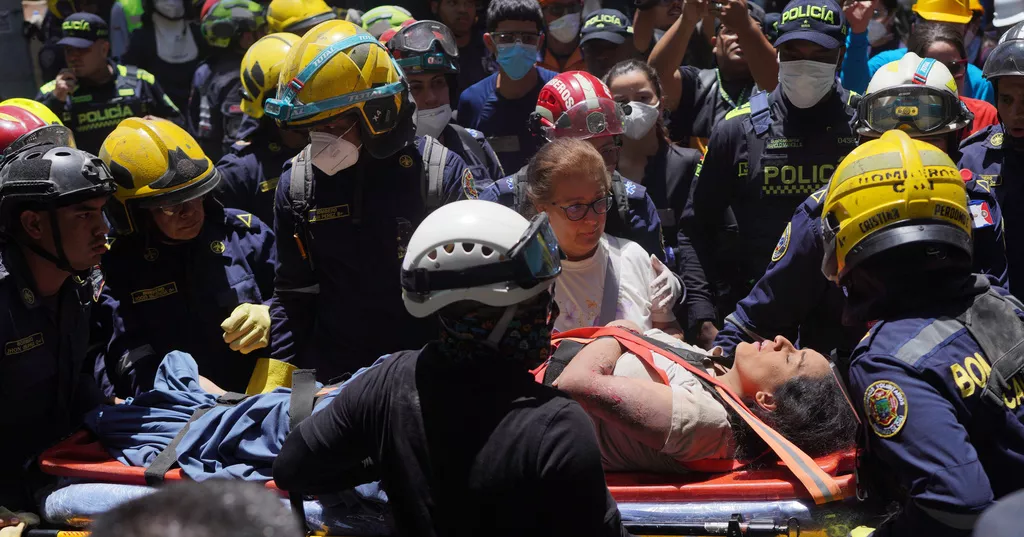
The search for survivors trapped under the rubble of Colombia’s powerful earthquake became increasingly urgent Wednesday as rescue teams raced against time to find signs of life.
The disaster has put new President Abelardo de la Espriella and his government under pressure as they work to respond to the emergency, while civil society groups are trying to deliver assistance to vulnerable communities hardest hit by the quake.
By Tuesday, de la Espriella said the magnitude 7.4 earthquake had killed at least 181 people and injured 2,595 others in western Colombia. He said at least 195 people remained missing, although databases maintained by civilian groups put the number closer to 4,000.
Search teams worked through the night in the worst-affected cities of Cali, Pereira, Manizales and Quibdo, as the chances of finding victims alive diminished with each passing hour.
Aid organizations consider the first 48 to 72 hours after a disaster critical for rescuing survivors, although the period can be extended when victims have access to food and water.
There have been moments of hope amid the destruction, including rescuers pulling a dust-covered baby through a gap in a concrete wall and crowds cheering as a woman was carried from the rubble on a stretcher.
In many areas, the government’s disaster response has been complicated by long-standing poverty and decades of armed conflict that have displaced large numbers of people.
“This earthquake compounds an already severe humanitarian situation, and there is a need for increased support for the humanitarian response,” said Giovanni Rizzo, Colombia director for the Norwegian Refugee Council.
The 2016 peace agreement between the government and rebels, along with the country’s continuing armed conflict, could help humanitarian organizations distribute food and other emergency supplies more quickly, said María José Torres, the U.N. resident coordinator in Colombia.
Humanitarian organizations already have a presence in several conflict-affected areas as a result of the peace process, including Choco, which was at the epicenter of the earthquake.
“We have a presence on the ground. Therefore, our ability to be there, present with the people, I think, has increased exponentially,” Torres said in a statement Tuesday.
Meanwhile, international governments and nonprofit organizations continued sending assistance to Colombia.
The United States has pledged more than $15 million in aid, while Mexican President Claudia Sheinbaum said her country was ready to deploy hundreds of search-and-rescue and health workers, along with tons of medical supplies and other equipment.
On Tuesday afternoon, Salvadoran President Nayib Bukele said El Salvador would send two planes carrying 100 tons of humanitarian aid in the coming days.
“Our prayers are with the families of the victims, the wounded and all the Colombian people,” Bukele wrote on X.