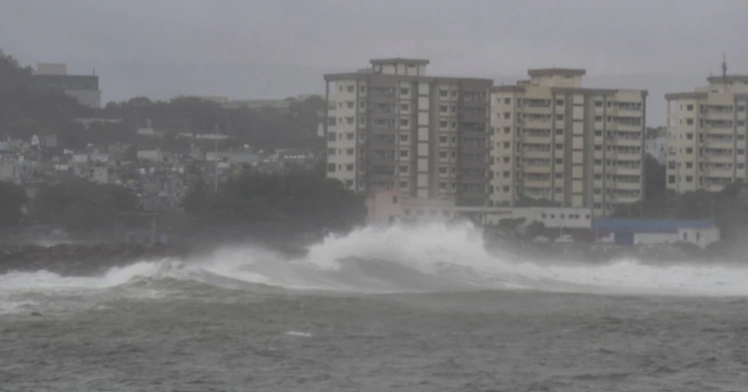
Cyclone Arnab completed its landfall along the Andhra Pradesh coast early Wednesday after a process lasting more than six hours, bringing heavy rainfall to parts of Andhra Pradesh and Odisha.
The India Meteorological Department (IMD), in a bulletin issued at 9:50 am, said the very severe cyclonic storm had moved completely over land along the Andhra Pradesh and Yanam coasts.
At the time of the bulletin, the cyclone was located around 20 km east of Narsapur, 40 km south-southwest of Yanam, 60 km south-southwest of Kakinada and 90 km east-northeast of Machilipatnam.
According to the IMD, Arnab crossed the coast with maximum sustained wind speeds of 125–135 kmph, with gusts reaching up to 150 kmph. The system subsequently weakened into a severe cyclonic storm at 8:30 am.
More Than 180,000 People Evacuated
The cyclone brought heavy rainfall to several districts in Andhra Pradesh and Odisha, prompting authorities to evacuate more than 180,000 people ahead of its arrival.
In Andhra Pradesh, Visakhapatnam recorded the highest rainfall, receiving 315 mm up to 8:30 am. Vizianagaram recorded 301 mm, followed by Anakapalli with 275 mm, Srikakulam with 257 mm and Krishna with 223 mm.
In Odisha, Koraput received 188 mm of rainfall, while Ganjam and Gajapati recorded 161 mm and 135 mm, respectively.
Airlines cancelled flights to Visakhapatnam and Vijayawada on Wednesday amid the adverse weather conditions.
No casualties had been reported in either state at the time of the report. However, electricity supplies were disrupted, trees were uprooted and some schools were closed. Several train services were also cancelled.
Officials forecast that heavy rainfall would continue in affected areas on Wednesday and Thursday as the cyclone's impact persisted.
How Cyclone Arnab Got Its Name
Bangladesh proposed the name Arnab, which is part of the official list of tropical cyclone names adopted in 2020 by the World Meteorological Organisation (WMO) and the United Nations Economic and Social Commission for Asia and the Pacific (ESCAP) Panel on Tropical Cyclones.
The name is associated with the Bengali word for the ocean or sea.
The regional naming list comprises 169 names contributed by 13 countries: Bangladesh, India, Iran, the Maldives, Myanmar, Oman, Pakistan, Qatar, Saudi Arabia, Sri Lanka, Thailand, the United Arab Emirates and Yemen. Each country submitted 13 names.
These names are used sequentially for tropical cyclones forming over the North Indian Ocean, including the Bay of Bengal and the Arabian Sea.
Cyclone naming helps distinguish individual weather systems, improve public awareness and reduce confusion when multiple storms occur simultaneously.
Source: NDTV