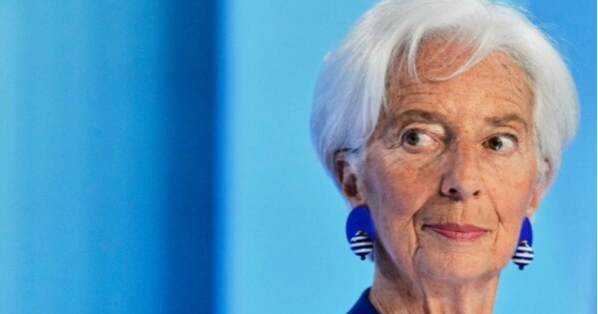
European Central Bank (ECB) President Christine Lagarde will step down on Feb 7, nine months before her term ends, allowing European Union leaders to select her successor before France's presidential election next year.
The ECB announced the decision on Thursday. Lagarde, 70, was originally scheduled to complete her eight-year term on Oct 31, 2027.
Her early departure will allow EU leaders to begin negotiations over her replacement, along with two other senior positions that will become vacant next year.
As ECB president, Lagarde leads the bank's governing council, which sets interest rates for the 21 countries using the euro. Its decisions influence borrowing costs for households and businesses, including loans for homes and factory investments. The bank also plays a key role in responding to economic and financial crises across Europe.
“It has been a great pride and a huge privilege to serve this institution,” Lagarde said in a video message posted on X, adding that she believed she was leaving the ECB well prepared for the future.
Asked about her decision at a news conference following the bank's decision to keep interest rates unchanged, Lagarde said she wanted greater freedom to speak publicly about issues beyond monetary policy.
“I want to, have the freedom of speech, the freedom of expression, and the freedom to engage on matters that are not monetary policy matters,” she said, adding that she was uncomfortable with the political neutrality required of her current position.
She did not provide further details.
Her resignation had been widely anticipated amid speculation that EU leaders wanted to appoint her successor while French President Emmanuel Macron, a strong supporter of European integration, remains in office.
The move could help prevent a potential victory by right-wing presidential candidate Marine Le Pen from influencing the selection process.
Holger Schmieding, chief economist at Berenberg bank, said Lagarde's early departure was not surprising and would not change the outlook for ECB policies.
European Council President Antonio Costa said the selection process would begin immediately and proceed without delay.
Two other senior ECB positions will also become vacant. Chief economist Philip Lane's term ends on May 31, while executive board member Isabel Schnabel is scheduled to leave on Jan 3 to join the International Monetary Fund.
EU leaders are expected to negotiate a package deal to distribute the three positions among member countries. Schmieding said they would likely seek an agreement before the European Council summit scheduled for Dec 17-18.
He identified former Dutch central bank governor Klaas Knot and Pablo Hernandez de Cos, general manager of the Bank for International Settlements, as leading potential candidates to replace Lagarde.
“The European Union is trying to guard itself at least somewhat against the risk that right-wing Marine Le Pen may win the French presidential election in April-May 2027,” Schmieding wrote in an email.
He added that Lagarde's successor would be appointed while Macron was still in office.
Lagarde, who previously headed the International Monetary Fund, became ECB president in 2019, succeeding Mario Draghi.
One of the major decisions during her tenure came in 2020, when the ECB launched a 1.35 trillion euro ($1.5 trillion) emergency bond-buying programme to keep credit flowing during the COVID-19 pandemic.
The central bank's ability to respond quickly has also made it a key player in managing major European crises, including the eurozone debt crisis of 2010-2012.
In 2012, Draghi famously pledged to do “whatever it takes to preserve the euro”, helping calm financial markets amid fears that the currency bloc could break apart.
Lagarde's resignation announcement overshadowed Thursday's decision by the ECB to keep its benchmark interest rate unchanged at 2.5%.
The decision came despite annual inflation reaching 3.8%, driven partly by higher oil prices linked to the US-Iran war. The ECB aims to keep inflation at 2%, and higher interest rates generally help control price increases by making borrowing more expensive.
However, analysts said rising bond yields were already making credit more expensive, helping to curb borrowing and spending without further action by the central bank.