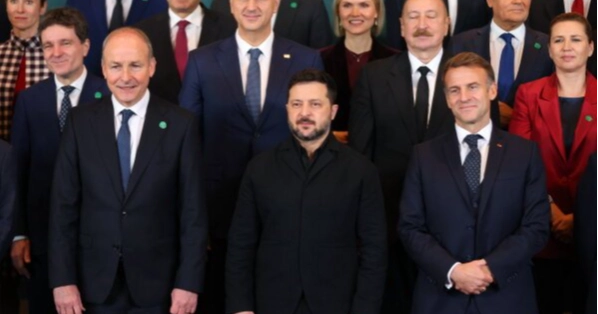
European countries are seeking a representative to join negotiations on ending the Russia-Ukraine war, fearing that a US-led process could leave them sidelined while Washington and Moscow determine the future of a conflict threatening the continent's security.
European Union leaders are expected to discuss the appointment at a summit in Dublin on Friday, but disagreements remain over who should represent Europe and whether the role should go to an individual or a group.
Ukraine wants stronger involvement from its European allies, reluctant to leave negotiations entirely in the hands of the US administration, which it believes has sometimes appeared sympathetic to Moscow. Russia, however, opposes European participation, accusing the countries of supporting Ukraine's military effort.
French President Emmanuel Macron said Europe must take responsibility for its own security, stressing that European support remains essential for Ukraine.
Italian Prime Minister Giorgia Meloni has called for a single EU representative to ensure Europe speaks with “a single, authoritative voice,” warning that separate diplomatic initiatives could weaken its position.
Irish Prime Minister Micheál Martin said Europe needed a coordinated negotiating position, extending beyond the EU to include Britain, Norway, Canada and other partners.
Several potential representatives have emerged, including European Council President Antonio Costa, EU foreign policy chief Kaja Kallas and Finnish President Alexander Stubb.
France, Germany and Britain, known as the E3, have so far played a prominent role in diplomatic efforts. German Chancellor Friedrich Merz described the grouping as an established format for negotiations.
However, relying on the E3 could exclude smaller EU countries, particularly those bordering Russia and Belarus.
US envoy Jared Kushner recently said Europe's ability to identify one representative would be a significant achievement in securing a place at the negotiating table.
Meanwhile, Kremlin spokesperson Dmitry Peskov said European countries must first agree on a representative before seeking involvement in the talks.
Latvian Prime Minister Andris Kulbergs warned that recent cyberattacks, arson and drone incidents highlighted the growing security threats facing Europe and the urgency of a coordinated response.