
European leaders found themselves hovering in Trump’s shadow earlier this month when the US president basked in acclaim at a ceasefire announcement in Egypt, flanked by world leaders who appeared more like supporting characters than decision makers. The scene underscored a growing concern in Europe: Washington’s “America First” foreign policy is increasingly sidelining its traditional allies.
While Trump has taken center stage in diplomacy over the Gaza conflict, major European governments have struggled to make their voices heard. And on Ukraine, a matter far closer to home, European capitals are finding it equally difficult to guide Trump’s approach to Russian President Vladimir Putin’s relentless war.
“Is Europe able to influence Trump? I think the short answer … is no,” said Lindsay Newman, a geopolitical analyst at GZERO Media. Policy on Ukraine, Israel and even ties with Europe are, she noted, shaped almost entirely by Trump and his closest advisers.
Newman added that the president’s ever-expanding foreign policy footprint challenges assumptions that “America First” meant US disengagement. “He's remaking the world in his image,” she said.
Mixed signals over Ukraine
Europe’s efforts to support Kyiv have frequently clashed with Trump’s desire to see the conflict end quickly, even if that requires territorial concessions from Ukraine. Attempts to secure stronger US backing have brought inconsistent results.
This week, Trump finally imposed sanctions on Russia’s vital oil and gas sector. The move followed persistent appeals from Kyiv and its allies, along with pressure from US lawmakers in both parties. Yet, by Trump’s own explanation, the sanctions stemmed more from irritation with Putin’s refusal to engage directly with Ukraine’s Volodymyr Zelenskyy than from any attempt to accommodate European demands.
“Every time I speak with Vladimir, I have good conversations, and then they don’t go anywhere,” Trump told reporters. “I just felt it was time. We waited a long time.”
Even so, Trump has openly expressed frustration that he has failed to deliver on his campaign promise to end the war quickly. He has alternated between publicly chastising Zelenskyy and seeking new avenues to negotiate with Moscow.
Though willing to consider deeper European involvement in enforcing any peace agreement, Trump has also appeared sympathetic toward Russian claims on the eastern Donbas region. His administration maintains that the conflict poses limited strategic significance for the United States and insists Europe must shoulder more responsibility.
Ukraine, European leaders oppose land concessions to Russia in peace talks
Despite disagreements, some European governments welcomed the new US sanctions. French President Emmanuel Macron described them as “a turning point.”
The EU still faces internal disagreements on Ukraine aid. A plan to tap frozen Russian assets for a large loan remains stalled, with Belgium seeking guarantees against potential retaliation and Hungary resisting support for Kyiv. Still, Grégoire Roos of Chatham House argued that Europe’s consensus has held together better than anticipated.
“I don’t see absolute unanimity, but I didn’t see unity crumbling significantly,” Roos said. “As far as Europe is concerned, this is already a victory.”
Little leverage on Gaza
Europe’s ability to shape the Gaza ceasefire has been even more limited.
“Europe has had no real impact, let’s face it,” said Roos, while noting that EU support will be essential for Gaza’s long-term reconstruction.
The bloc remains the largest donor to Palestinians but divided over how to approach the conflict. Trump has highlighted the roles of Egypt, Qatar, Turkey and Saudi Arabia in brokering the ceasefire while downplaying Europe’s involvement. His ambassador to Israel, Mike Huckabee, went as far as calling a British official “delusional” for claiming the UK was crucial to the deal.
Washington’s irritation has grown after several European states, including Britain and France, recognized a Palestinian state in recent weeks.
Still, analysts say the ceasefire has eased tensions between Europe and Washington by temporarily muting European criticism over Israel’s actions in Gaza.
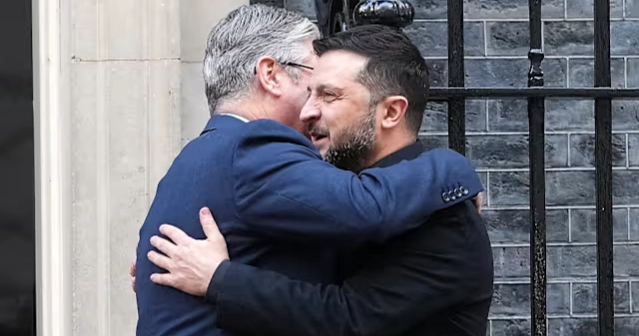
Zelenskyy seeks more European support against Russia during London trip
Jonath Schanzer of the Foundation for Defense of Democracies said the development created “a more constructive” atmosphere between allies.
Newman, meanwhile, observed that Trump appears intent on building deeper ties in the Middle East. “There have been efforts to pivot away from the Middle East for successive U.S. administrations,” she said. “But it’s almost as though there’s a pivot toward the region.”
Europe steadies itself
The war in Ukraine and heightened threats toward NATO states have jolted Europe into accelerating defense spending, spurred by Trump’s repeated warnings that the US may not defend members failing to pay their share.
Some European fears have not materialized. Trump has kept US troops stationed on the continent, avoided quitting NATO and held back from imposing steep tariffs on European products.
Britain, now outside the EU, has drawn closer to its European neighbors as Prime Minister Keir Starmer works to ensure coordination with the White House.
Kathleen Burk, professor emeritus at University College London, said that a unified Europe can still have influence on the Oval Office.
“If the Europeans hang together,” she said, “Trump may have actually realized that it’s always better to have allies than enemies.”
Source: AP