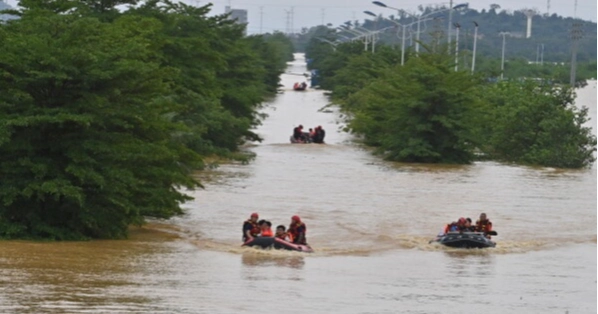
Flooding caused by days of heavy rain in southern China has killed at least 39 people, authorities said Thursday, as another powerful storm approaches the country's eastern coast and Taiwan.
Most of the deaths occurred in Hengzhou, where part of a reservoir dam collapsed, sending floodwaters into nearby communities and killing 26 people, said Ding Wei, vice mayor of Nanning, which oversees the area. Nine people are still missing across the Guangxi region.
Tropical Storm Maysak brought record rainfall to Guangxi from Saturday, causing reservoirs to overflow, flooding homes and leaving many people stranded for days. Authorities had earlier reported six deaths on Tuesday, but the toll has since risen sharply.
Meanwhile, Typhoon Bavi is moving northwest across the sea and is expected to pass near remote Japanese islands before moving north of Taiwan and making landfall in China's Fujian or Zhejiang province on Saturday.
Fishing boats crowded ports in northern Taiwan on Thursday as residents prepared for heavy rain and strong winds.
Although Bavi weakened from a super typhoon on Thursday, Taiwan's Central Weather Administration said it was still packing maximum sustained winds of 184 kilometres (114 miles) per hour.
In the Philippines, classes were suspended in several cities and towns, while ships were barred from leaving northern ports as the storm passed east of Luzon.
In flood-hit Guangxi, military rescue teams completed the evacuation of more than 10,000 students and teachers trapped in several schools in Guigang city, about 60 kilometres northeast of Hengzhou.
Footage aired by state broadcaster CCTV showed students wearing orange life jackets boarding rescue boats as floodwaters surrounded school buildings.
The flooding also affected wildlife and domestic animals.
A zoo in Guigang reported that more than 100 animals, including two zebras, four porcupines and dozens of tropical birds, were missing after the flood.
In Hengzhou, authorities warned residents about snakes believed to have escaped from a farm. They stocked up on anti-venom and issued safety advice on snake bites.
An animal shelter in Binyang County, around 75 kilometres northwest of Hengzhou, worked to rescue about 200 cats and dozens of dogs. Shelter workers carried dogs through deep floodwater while cats climbed onto roof beams to escape the rising water.
Authorities said drones and around 5,700 boats have been used in large-scale rescue efforts to deliver drinking water and other emergency supplies and evacuate stranded residents. Around 130,000 people have been moved to safer places.
Ding said floodwaters are gradually receding, but more rain is forecast in some areas over the next two days.
Cleanup crews have been deployed to remove mud and debris and disinfect affected towns in Hengzhou. Road repairs are continuing, while electricity has already been restored to more than 60,000 households.
China's National Meteorological Center said parts of Guangxi received between 10 and 40 centimetres (4 to 16 inches) of rain over the past several days, with some of the worst-hit areas recording more than 90 centimetres (35 inches).
Severe weather also struck central China's Hubei province earlier this week, where thunderstorms and tornadoes killed 11 people and left many others homeless.
Elsewhere in Asia, landslides triggered by monsoon rains have killed at least 13 Rohingya refugees in camps in Bangladesh this week, with authorities continuing efforts to move vulnerable families to safer locations.