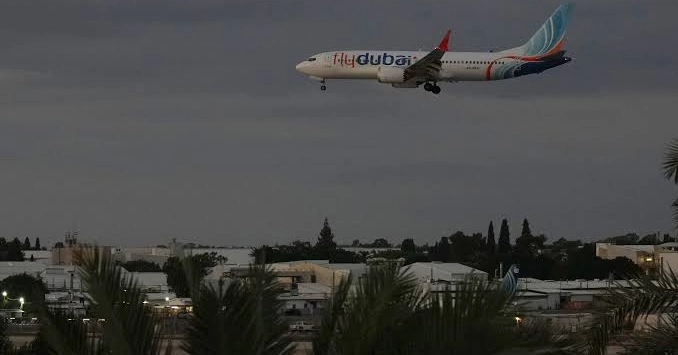
The FlyDubai co-pilot accused of stabbing the captain in an apparent attempt to bring down a flight carrying 182 people had previously been prohibited from flying in his home country of Oman because of concerns about extremist views, a source familiar with the matter told The Associated Press on Saturday.
Meanwhile, a Palestinian citizen of Israel who was seeking election in Israel has decided to withdraw his candidacy following controversy over comments he made about Hamas’ Oct. 7 attack on Israel.
Oman barred co-pilot from flying over extremism concerns
The FlyDubai co-pilot who authorities say nearly caused a plane carrying 182 passengers to crash had earlier been banned from flying in Oman amid concerns over his alleged extremist beliefs, according to a person familiar with the case.
The source, speaking anonymously because of the ongoing investigation, said the co-pilot was later employed by the Dubai-based airline. It remains unclear how thoroughly he was screened before being hired in the United Arab Emirates. The Wall Street Journal first reported that Oman had prohibited him from flying.
Injured captain says he returned to cockpit to protect passengers
Indian airline Captain Smit Machchhar, who helped stop what appeared to be an attempt to crash a flight headed for Tel Aviv, told Indian Prime Minister Narendra Modi that he realized he had to regain his footing to protect those on board.
Speaking from a hospital in Abu Dhabi, Machchhar said he had suffered multiple injuries and had collapsed after being attacked by his co-pilot. He said he understood that unless he managed to get back up, the passengers could lose their lives.
Machchhar was seriously wounded during Wednesday’s incident but succeeded in opening the cockpit door. Passengers then entered the cockpit and restrained the attacker as the Boeing 737 went into a steep descent, according to witnesses and Israeli authorities.
Tanker hit by projectile in Strait of Hormuz
A tanker traveling through the Strait of Hormuz was hit by an unidentified projectile while heading out of the strategic waterway, the British military said Friday. The incident caused a small fire and a temporary loss of power aboard the vessel.
The United Kingdom Maritime Trade Operations Center said there were no reported casualties. The fire was put out and the tanker continued its journey.
Authorities did not disclose the name of the tanker, and no group immediately claimed responsibility. UKMTO said four other tankers had recently been struck by projectiles in the strategic waterway, bringing the total number of affected vessels to five.
Shipping activity through the Strait of Hormuz remains below levels recorded before the war, as do energy shipments. However, Iran’s ability to restrict traffic through the waterway has been reduced by U.S. Navy efforts to escort oil tankers. Together with the use of pipelines, this has enabled Gulf producers to bring oil exports close to prewar levels.
Israeli strikes kill three in Gaza
Three Israeli attacks in Gaza City and central Gaza killed three people and injured at least one other on Friday, according to health officials at hospitals in the territory.
Two strikes in Gaza City each killed one person, while a separate attack in central Gaza killed another, officials said.
The Israeli military confirmed carrying out the attacks, saying it had targeted militants in the areas but providing no further details.
Fighting intensifies in Yemen as UN warns of worsening humanitarian crisis
Heavy clashes broke out in a residential district of Taiz City in Yemen as fighting between Iran-backed Houthi forces and government troops supported by Saudi Arabia raised fears that the humanitarian crisis could deteriorate further.
The World Food Program warned that renewed violence was making an already severe humanitarian situation even worse. WFP director Matthew Hollingworth said nearly three-quarters of Yemeni households are struggling to obtain enough food to meet their basic needs.
An Associated Press reporter in Taiz said Houthi shelling struck the residential Wadi al-Qadi neighborhood on Friday, injuring several people.
Saudi Arabia separately announced Friday that its forces had intercepted three ballistic missiles launched by the Houthis toward Khamis Mushait. Saudi military spokesman Gen. Turki al-Maliki did not say when the missiles were fired and reported no immediate damage.
Saudi Civil Defense also said a fourth projectile, which it attributed to the Houthis, struck a school in Najran, causing property damage. No injuries were reported.
Palestinian candidate withdraws from Israeli election
Sami Abou Shehadeh, chairman of Israel’s left-wing Balad party, said he would withdraw from the upcoming Israeli election after the president of the country’s Supreme Court indicated that most justices were likely to support his disqualification.
Abou Shehadeh’s candidacy came under challenge because of an opinion article he published in Al-Araby al-Jadeed one day after Hamas’ Oct. 7 attack on Israel. The article did not condemn Hamas and suggested that, given conditions in Gaza, it was surprising that violence had not erupted sooner.
In a later article, Abou Shehadeh, a former member of the Knesset, described the Hamas attack as both unacceptable and criminal. He said he was unaware of the full extent of the violence when he wrote his initial article.
The Supreme Court considered whether his statements violated Israeli legislation that prevents candidates from rejecting Israel’s existence, inciting racism or supporting armed struggle against the country. His lawyers argued that disqualifying him would amount to expanding the interpretation of the law and establishing a new legal standard.
Palestinians make up roughly one-fifth of Israel’s population.
Israeli troops prevent Palestinians from harvesting olives in West Bank
Israeli soldiers prevented Palestinian farmers and activists from collecting olives in the northern West Bank, according to video footage obtained by The Associated Press.
The footage showed Israeli troops firing shots into the air and using tear gas against Palestinian farmers and activists. Israeli settlers were also visible in the area.
The Israeli military said its troops had been deployed after receiving reports of a confrontation and that the incident was subsequently dispersed. The military added that a security official at the scene had earlier fired shots into the air but did not provide further details. No injuries were reported.
Olive harvesting in the West Bank has frequently been accompanied by tensions between Palestinian farmers and Israeli settlers. This year, Israel introduced additional restrictions preventing Palestinians from harvesting in areas known as Area C, which remains under Israeli security control and contains most of the West Bank’s agricultural land.