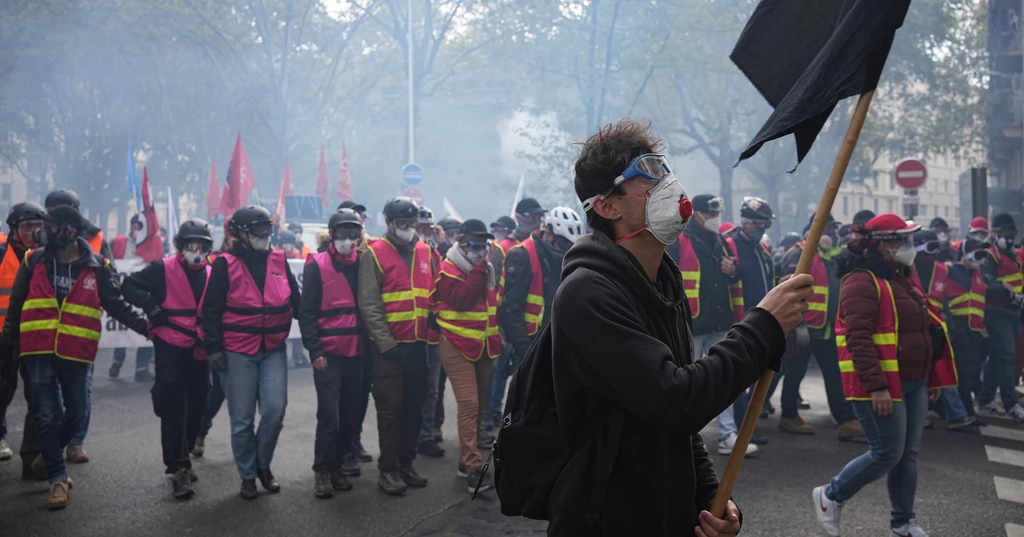
Tens of thousands of trade union members joined nationwide strikes and demonstrations across France on Thursday, demanding higher wages and backing a growing student protest movement, putting further pressure on President Emmanuel Macron’s government.
Major rallies were held in Paris, Lyon, Marseille and other cities after more than a month of recurring protests. Unions said around 260 demonstrations against rising living costs were planned across the country, with hundreds of thousands of people expected to take part.
Students also staged fresh protests, leaving about one-third of the country’s high schools closed or unable to operate due to student blockades and teacher strikes. Public transport services faced major disruptions, while the Eiffel Tower was also closed.
Despite heavy security, the atmosphere remained largely peaceful at Paris’s Place de la République, where the main march was scheduled to begin in the afternoon. The area had witnessed clashes between rioters and police during protests on October 17.
Interior Minister Laurent Nuñez said 70,000 police officers had been deployed, supported by armoured vehicles, drones and helicopters.
However, violence was reported in some areas. Authorities in Brittany said masked individuals attempted to block roads in Rennes, while young people, sometimes accompanied by adults, committed serious acts of violence, including throwing steel balls at police.
France’s major unions warned that the country was nearing recession and that job-cutting plans were increasing. They said the prices of fuel, food, rent, gas and electricity were rising while wages and pensions remained stagnant.
“The situation in this country is fragile. The pressing social and environmental challenges must be addressed without delay,” the unions said in a joint statement.
Fabien Villedieu, national secretary of the SUD-Rail union, criticised the government, railway operator SNCF and employers for failing to address workers’ concerns.
“When they’re not reasonable, we simply do what we’ve always done in France, which is to go on strike,” he told The Associated Press.
The government had held talks with unions ahead of the strikes in an effort to contain the unrest, which has become the country’s worst civil disturbance in years.
The protest movement began in September following demonstrations over staff shortages at a high school southeast of Paris. It later spread nationwide, drawing students demanding increased education funding and workers seeking better pensions and relief from rising fuel and living costs.
The protests are also unfolding as political parties prepare for next May’s presidential election. Macron is constitutionally barred from seeking a third consecutive term, while candidates are seeking to capitalise on public discontent.
Paul Smith, an associate professor of French history and politics at the University of Nottingham, said the next president would face major challenges amid widespread frustration over the government’s performance.