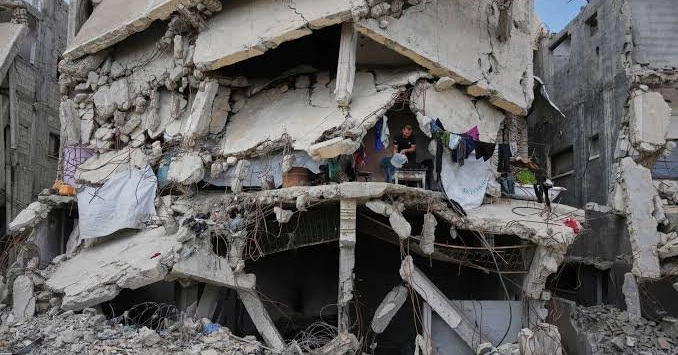
A year after a ceasefire agreement brokered by US President Donald Trump and Arab allies raised hopes of ending the war in Gaza, progress has stalled, with Israel continuing deadly strikes on the devastated Palestinian territory.
The agreement halted major military operations, secured the release of all remaining hostages and improved humanitarian access. However, key commitments, including establishing a new Palestinian administration backed by international forces, disarming Hamas and ending Israeli control over large parts of Gaza, remain unfulfilled. Reconstruction has barely begun.
Israel has linked further progress to Hamas' complete disarmament, while the Palestinian group and the Trump administration have argued that disarmament and other steps should proceed simultaneously.
Israeli Prime Minister Benjamin Netanyahu hardened his position over the summer, openly rejecting an agreement announced by Trump, Israel's most important ally, ahead of Israeli elections scheduled for later this month.
The deadlock has left Gaza's two million Palestinians facing an uncertain future. Most are living in overcrowded, rodent-infested tent camps, among the ruins of their former neighbourhoods or inside damaged buildings at risk of collapse.
Early progress raised hopes for peace
The 20-point ceasefire agreement followed months of negotiations under the administrations of former US President Joe Biden and Trump. It halted major military operations and led to the return of all remaining hostages captured during Hamas' October 7, 2023, attack that triggered the war.
Hamas-led militants killed around 1,200 people and abducted 251 others in the attack. Israel responded with extensive airstrikes and a ground offensive that has killed more than 74,000 Palestinians, according to Gaza's Health Ministry.
The ministry, which operates under the Hamas-run government, maintains detailed records and is generally considered reliable by UN agencies and independent experts. Its death toll does not distinguish between civilians and combatants, but the ministry says women and children account for about half of those killed.
After the ceasefire was announced, Trump called for a new era of peace in the Middle East.
“We have a once-in-a-lifetime chance to put the old feuds and bitter hatreds behind us,” he said at a summit marking the agreement.
Key commitments remain unfulfilled
The agreement called for Hamas to transfer power to a committee of Palestinian administrators vetted by the Board of Peace, a new body chaired by Trump and tasked with implementing the ceasefire.
Hamas formally dissolved its government in July but retained the civil service. The group remains the dominant force in the roughly 40% of Gaza not controlled by Israeli troops. Meanwhile, Israel has prevented the new Palestinian administration from entering Gaza through Egypt.
Plans for an International Stabilization Force were announced in February, but the force has yet to be established. Indonesia, which pledged the largest contingent of 8,000 troops, suspended its plans last spring as international attention shifted to the war involving Iran.
Israel was also expected to withdraw from Gaza under the agreement. Instead, it has taken control of additional territory, pushing the so-called Yellow Line of Control westward towards the Mediterranean Sea.
Israeli forces have continued carrying out strikes against people they accuse of violating the ceasefire, approaching the Yellow Line or participating in the October 7 attack. Such strikes have frequently killed civilians.
Israel's attacks have killed more than 1,400 Palestinians since the ceasefire took effect, according to Gaza's Health Ministry. Sporadic attacks have also killed five Israeli soldiers in Gaza during the same period.
Netanyahu's rejection deepens the deadlock
In July, Trump announced an agreement on disarming Hamas, describing it as a breakthrough in the stalled peace process.
The proposed arrangement, an extension of the original ceasefire, called for Hamas to disarm “in a gradual, sequential and time-bound manner” linked to an Israeli withdrawal in phases.
Hamas confirmed for the first time that it had agreed to disarm, but said the process must also involve an end to Israeli strikes and a withdrawal of Israeli forces from Gaza.
Days later, Netanyahu declared that Israel would not withdraw from any part of Gaza until Hamas had been completely disarmed, directly rejecting the arrangement announced by Trump.
The disagreement marked a rare public rift between the two allies. It also came as Netanyahu sought to strengthen support among nationalist voters ahead of the October 27 election, which could end his nearly uninterrupted 17-year rule, the longest in Israeli history.
Netanyahu has faced criticism over security and intelligence failures before the October 7 attack. His opponents have accused him of being too lenient towards Hamas, leaving him with little political room for even limited concessions on Gaza before the formation of a new government, a process that could take months.
For now, reconstruction remains largely absent, Hamas has been weakened but continues to hold power in parts of Gaza, and the possibility of renewed fighting remains.