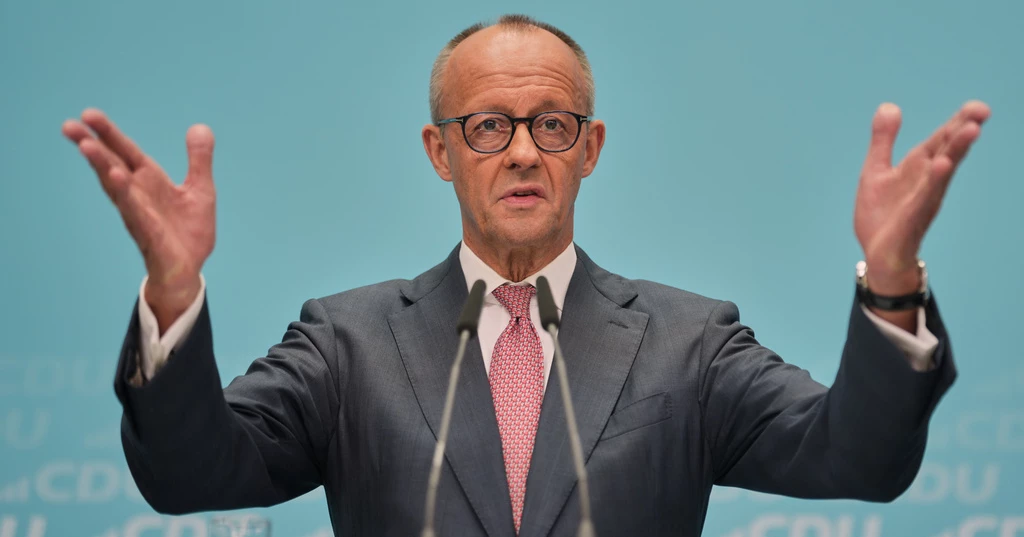
German Chancellor Friedrich Merz reaffirmed Monday that he would remain in office after his party suffered two more regional election defeats and, for the first time, lost its representation in a state legislature, in a humiliating setback that could make it harder for him to pursue his reform agenda.
Shortly after polls closed Sunday, the unpopular Merz said he intended to remain leader of both Germany and his center-right party and pledged to continue pushing reforms aimed at strengthening Europe's largest economy.
But final results released hours later highlighted the scale of what Merz himself described as a "disaster" in Mecklenburg-Western Pomerania, an eastern state on the Baltic Sea coast.
His center-right Christian Democratic Union (CDU) received just under the 5% threshold required to retain seats in the state parliament, marking the first time this has happened in the 77-year history of modern Germany's federal republic. The CDU lost more than half of its support, while the far-right Alternative for Germany (AfD) emerged as the strongest party.
In Sunday's other election, the CDU fell to second place in Berlin, behind the hard-left Left Party, which is in a strong position to lead the next city government. However, depending on the outcome of coalition negotiations, Merz's party could still retain control of city hall.
Despite days of speculation over Merz's political future, there were no prominent public calls for his resignation Monday and no indication of a leadership challenge.
Merz said no one had raised any "personnel questions" at party leadership meetings on Sunday or Monday.
"It is the historic task of the (governing) coalition here in Berlin and the political center as a whole to make our country fit for the coming years," Merz said.
"Extremists suggest that there are easy solutions. But everyone who has ever governed knows there are no easy solutions," he said.
At the same time, Merz acknowledged that the CDU needs to strengthen its political profile.
He said the party "no longer has satisfactory answers to too many questions, and we will and must change that."
Far-right party makes further gains
Neither of the two states that held elections Sunday is considered a major political heavyweight.
The CDU's victory in Berlin in 2023 was its only election win there in the past 25 years, while the capital has traditionally leaned to the left. The party was already relatively weak in Mecklenburg-Western Pomerania.
However, the latest results add to the political difficulties facing Merz following the CDU's stinging defeat by the far-right, anti-immigration AfD two weeks ago in Saxony-Anhalt, another region of the former communist east.
That defeat weakened Merz's authority and triggered speculation that he could eventually be replaced.
Although the AfD emerged as the strongest party in Mecklenburg-Western Pomerania, the center-left Social Democrats, the junior partner in Merz's national governing coalition, finished relatively close behind.
Their campaign focused heavily on state Governor Manuela Schwesig as a defender against the far right. That polarization helped squeeze other mainstream parties, including the CDU.
A left-leaning three-party coalition led by Schwesig would hold a majority in the new state legislature.
Dispute over Germany's reform plans
Schwesig and other figures in the governing parties have questioned parts of the federal government's reform agenda, which is intended to address Germany's chronically sluggish economy.
The proposed reforms include potentially painful changes to the pension and healthcare systems.
One particularly controversial proposal would scrap a rule allowing people who have paid pension contributions for 45 years to retire early without suffering a financial penalty. The proposal has faced strong criticism.
The Social Democrats' national leaders said Monday that they remain committed to the coalition, but made clear that they want at least some changes to the government's plans.
Vice Chancellor Lars Klingbeil, who is also finance minister, said that "saying we will ignore what voters told us in three state elections won't work."
"We need reforms, but these reforms must be fair and they need support in the population," he said.
The party's other co-leader, Labor Minister Bärbel Bas, said the reform plans need a "reality check" as well as a "fairness check."
However, she said she was optimistic that solutions could be found on pension reform, which is the most controversial of the government's plans.
"There would be nothing more lethal than letting this coalition break apart over some technical question," Bas said.
Merz said he would not speculate about "where we must make corrections."
There are no further state elections scheduled for the remainder of this year. Five state elections are due to be held next year, including three in April.
One of them will take place in North Rhine-Westphalia, Germany's most populous state, which is currently led by prominent CDU figure Hendrik Wüst, who is often mentioned as a possible successor to Merz.
None of the five elections next year will be held in the east, where the AfD has its strongest support.
Looking ahead, much could depend on the CDU's influential regional leaders. But there was no indication Monday that they or others were preparing a challenge to Merz.
"You get the feeling that the stronger figures are trying to stay away from Berlin at the moment," Thomas Poguntke, a longtime political science professor at Heinrich Heine University in Duesseldorf, told Phoenix television.
"Swapping out a leadership figure wouldn't achieve so terribly much now," he said, while noting that the chancellor had made avoidable mistakes in the past and that "the government's handicraft simply must improve."