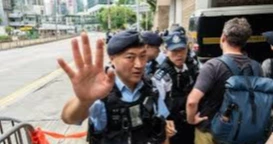
Prominent Hong Kong pro-democracy activist Joshua Wong pleaded guilty Wednesday to a charge of conspiring to collude with foreign forces to endanger national security under a Beijing-imposed law.
It is the second national security case against Wong, a former student leader and one of the best-known figures of Hong Kong's pro-democracy movement.
The national security law was introduced in Hong Kong in 2020 following months of massive anti-government protests in 2019. Authorities say the law is necessary to protect national security and maintain stability, while critics say it has severely restricted political freedoms and silenced dissent.
Wong, 29, appeared thinner as he arrived at court wearing a blue shirt.
He is expected to be sentenced later. The offense carries a prison term of three to 10 years, while cases considered “of a grave nature” can result in life imprisonment. A guilty plea can lead to a reduced sentence.
Wong is already serving four years and eight months in prison after pleading guilty in a separate national security case linked to an unofficial political primary. He had been expected to be released next January before his arrest in June 2025 over the latest charge.
Prosecutors alleged that Wong and fellow activist Nathan Law had agreed years ago to seek international support for democratic self-determination in Hong Kong.
They said that after the national security law came into effect, Law and other activists who had left Hong Kong continued campaigning overseas by meeting foreign politicians and organizing petitions.
According to prosecutors, Wong supported those efforts from Hong Kong by using foreign media and social media, including sharing Law's posts, to encourage other countries to impose sanctions, blockades or other measures against Hong Kong and China.
Prosecutors also referred to a Facebook post in which Wong shared an online petition urging digital forensic companies to stop cooperating with Hong Kong police.
They said one company later announced that it would stop selling its digital intelligence products to customers in Hong Kong and mainland China.
The prosecution further alleged that Wong claimed in a work report that he had helped end the company's supply of forensic software to police and had contacted foreign companies over their cooperation with the Chinese government.
Wong told the court that he agreed with the details presented by prosecutors.
Before the hearing, a supporter shouted, “Hang in there,” as Wong arrived at court.
His friend Louis Lee said Wong had spent his time in prison reading books, studying, learning guitar and exercising.
“I believe he and I, or friends outside, we will do our best in our own roles and continue to work hard in our fields,” Lee said.
Wong first gained public attention in 2012, when he was a high school student leading protests against the introduction of national education in Hong Kong schools.
He later became a prominent figure in the 2014 Occupy Movement.
In 2016, Wong co-founded the political party Demosisto with other young activists, including Law, who became Hong Kong's youngest lawmaker that year.
During the large-scale protests in 2019, Wong sought international support for the democracy movement, including from the United States. Chinese authorities accused him of seeking foreign interference in Hong Kong.
Demosisto was dissolved after Beijing imposed the national security law in 2020.
Many other prominent activists have also been jailed under the law, including former media tycoon Jimmy Lai, while others have left Hong Kong for countries such as the United States and Britain.
Hong Kong authorities have separately offered rewards of 1 million Hong Kong dollars ($127,600) for information leading to the arrest of Law and other activists living overseas.