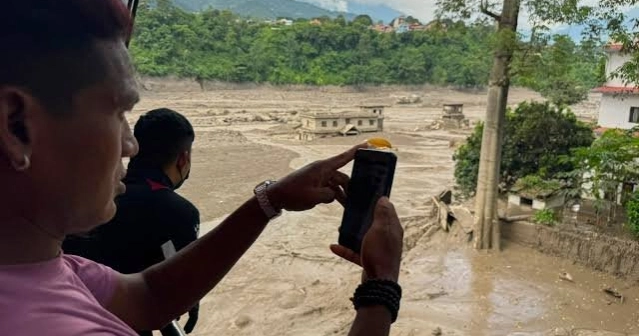
At least eight people were killed and hundreds remained missing after an avalanche of ice and rocks triggered massive flash floods in parts of Nepal on Wednesday, sweeping away villages and damaging roads and other infrastructure.
Officials said 384 tourists were reported missing, including 291 visitors from India, the United States, the United Kingdom and Malaysia.
The Bhotekoshi River overflowed around 9 a.m., flooding several villages and damaging roads and hydropower projects, officials said. Authorities warned people in several districts to stay away from the banks of the Bhotekoshi, Trishuli and Narayani rivers.
“We have asked both India and China to help us with the rescue efforts,” Nepali government spokesperson Sasmit Pokharel said.
Rasuwa district was among the worst-hit areas. The district experienced similar flooding in August last year after a glacial lake in neighboring Tibet overflowed amid rising temperatures in the mountain region. Nine people were killed and key infrastructure, including a bridge linking Nepal and China, was damaged at the time.
Climate experts at the Kathmandu-based International Centre for Integrated Mountain Development said an avalanche from a glacier likely caused Wednesday’s flooding.
The Lhende Khola River, a tributary of the Bhotekoshi, saw the highest level of flooding, they said.
“The Lhende Khola has flooded twice in 14 months, this time after an ice-rock avalanche from a glacier on the Nepal side blocked the river and sent a sudden surge downstream,” said Saswata Sanyal, a disaster risk reduction specialist at the organization.
“In a warming Himalaya, early warning is the first line of adaptation,” he said.
The Himalayan region, which includes Nepal and parts of several neighboring countries, including India, is highly vulnerable to floods, landslides and heavy rainfall. Experts say the region is warming faster than the global average because of human-driven climate change.
Extreme weather events such as heatwaves, heavy rainfall and glacier melt have become more frequent in the region.
Researchers at the Kathmandu-based organization said earlier this year that glaciers across the Hindu Kush Himalaya are melting at an accelerating pace, with the rate of ice loss doubling since 2000, largely due to rising global temperatures and climate change.