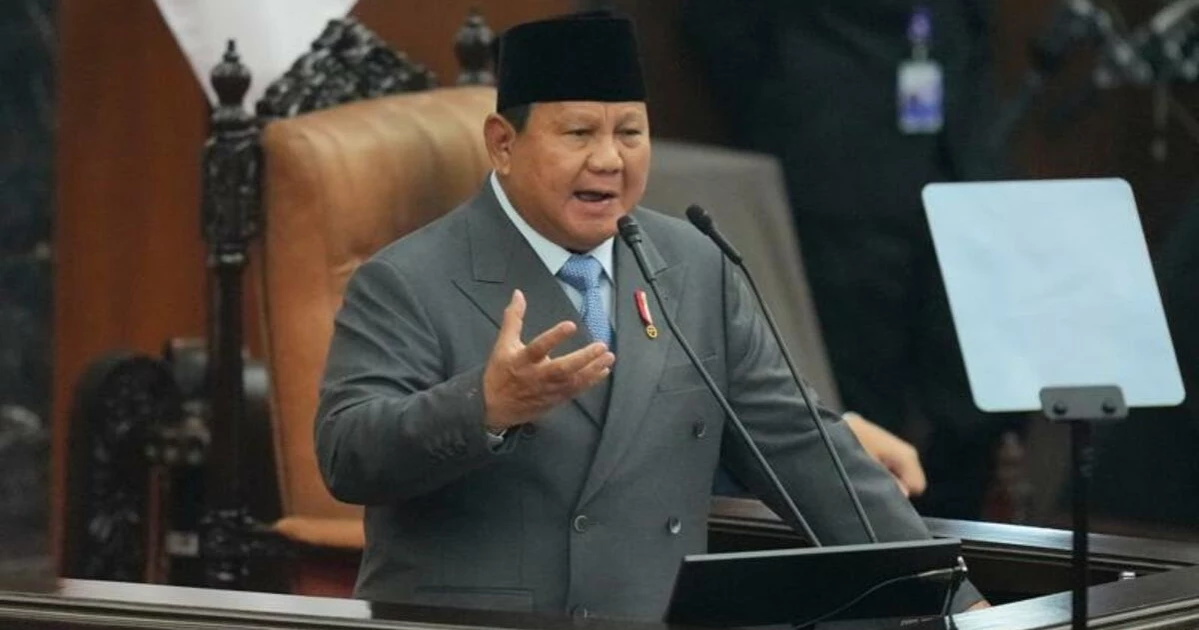
Indonesia's military is sending more than 20,000 troops and personnel to the capital, Jakarta, as authorities investigate an alleged illegal wiretapping operation targeting President Prabowo Subianto that has resulted in the detention of three senior police generals.
The controversy has intensified after the presidential palace described the alleged surveillance of the president as conduct that could amount to "leading toward treason."
Officials warned that access to sensitive communications involving the head of state could threaten national security and endanger the country's leadership.
The scandal has also implicated presidential chief of staff Gen. Listyo Sigit Prabowo. There are further allegations that Cabinet members, politicians, journalists, civil society representatives and business executives were subjected to unauthorized surveillance.
Thousands of troops move into Jakarta
Authorities have not confirmed whether the military deployment is directly connected to the wiretapping investigation.
The initial deployment began Monday, involving 2,100 personnel from military units already stationed in Jakarta. Additional troops from outside the capital were scheduled to arrive Wednesday, bringing the total number of deployed personnel to 20,980, navy operations assistant Vice Adm. Yayan Sofiyan said.
The deployment includes marine and naval units, training centres and naval bases from Java and Lampung province.
Another 13,140 personnel remain on standby for possible deployment, Sofiyan said.
He did not explain the specific purpose of the operation or clarify whether the authorities were concerned about security threats or political tensions in the capital.
Indonesian armed forces spokesperson Maj. Gen. Muhammad Nas described the deployment as a routine measure to maintain national security and territorial integrity.
"Troop deployments are a normal occurrence," Nas said, adding that the military must remain prepared to defend the country and protect the integrity of the Republic of Indonesia.
Presidential palace raises national security concerns
State Secretariat Minister Prasetyo Hadi said Wednesday that the alleged surveillance of the president had raised serious concerns about national security.
"If we are talking about a head of state, there is a great deal of highly sensitive information that could potentially be used for purposes that endanger the interests of the nation," Hadi told a news conference at the presidential palace.
He said the alleged actions could be considered an attempt leading towards treason because they threatened state interests and national leadership.
Hadi added that the government was waiting for the outcome of the police investigation before determining the suspects' motives.
Three senior police generals detained
Indonesian police announced late Tuesday that three senior police generals had been detained as suspects in the alleged illegal wiretapping case.
The suspects are Listyo, Ahrie Sonta Nasution and Eko Hadi Santoso. Police said they were detained Sunday over allegations involving unlawful interception of communications, unauthorized access to electronic systems and deletion of electronic data.
According to investigators, the alleged surveillance took place between 2025 and 2026, when Listyo was serving as the country's police chief. The suspects allegedly ordered the wiretapping without following established procedures.
They are also accused of instructing the deletion of files containing intercepted communications in late October to conceal evidence and remove traces of the operation.
The authorities have not established who may have ordered the surveillance or what its ultimate purpose was.
Bambang Rukminto, a police analyst at the Institute for Security and Strategic Studies, said the alleged targeting of a sitting president raised more serious questions than surveillance involving business executives, political leaders or other public figures.
He noted that monitoring less prominent individuals could potentially serve purposes such as intimidation or gaining political influence, but such explanations would be difficult to apply to the president.
"If the target is the president, what would the motive be? Intimidating the president is clearly not a plausible explanation," Rukminto said.
He stressed that investigators should identify not only those who allegedly conducted the surveillance but also its intended purpose and the parties that could have benefited from the information.
The three suspects could face charges involving unlawful interception, recording, diversion, alteration, obstruction or monitoring of private electronic communications. Such offences carry a maximum prison sentence of 10 years.
The suspects have not made any public statements responding to the allegations.
Experts question possible political motives
Adrianus Meliala, a criminologist at the University of Indonesia and former commissioner of the National Police Commission, questioned whether the alleged surveillance had been conducted to serve interests outside the police force or the state.
"There is a strong suspicion that the wiretapping was carried out not in the interests of the state or the National Police, but for the interests of other parties," Meliala said.
He added that, if proven, the allegations could be linked to political manoeuvring involving members of the police force.
Meliala said Listyo's inclusion among the suspects had been unexpected but stressed that those involved in political activities must also be prepared to face the consequences.