
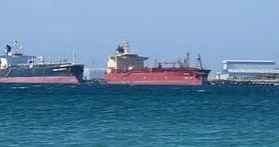
The ongoing war involving Iran has not only brought oil tanker traffic through the Strait of Hormuz to a near standstill, but is also straining broader global supply chains, disrupting the movement of goods ranging from Indian pharmaceuticals and Asian semiconductors to fertilizers and petrochemical products from the Middle East.
Cargo vessels are either stranded inside the Gulf or rerouting around Africa’s Cape of Good Hope, adding time and cost to deliveries. Meanwhile, air cargo operations across parts of the Middle East have been curtailed, raising concerns about shortages and rising prices if the conflict persists.
Patrick Penfield, a supply chain expert at Syracuse University, warned that prolonged instability would likely trigger supply shortfalls and significant price hikes worldwide.
Shipping bottlenecks spread
According to Clarksons Research, roughly 3,200 vessels — about 4% of global shipping tonnage — are currently idle inside the Persian Gulf, though many operate only regionally. Another 500 ships are reportedly waiting outside the Gulf near ports in the United Arab Emirates and Oman.
While the share may appear limited, industry experts caution that disruptions at key chokepoints can ripple through the global logistics network. Michael Goldman of CARU Containers compared the supply chain to a train, where a derailment in one segment can affect multiple links along the route.
In response to the crisis, U.S. President Donald Trump announced measures aimed at restoring tanker traffic through the Strait of Hormuz. He said the U.S. International Development Finance Corp. would offer political risk insurance for ships transiting the Gulf and indicated the U.S. Navy could escort tankers if needed. The Navy maintains multiple destroyers and littoral combat ships in the region.
Key goods face delays
Beyond oil — roughly 20% of which transits the region — the Middle East is a major exporter of natural gas–based products such as petrochemical feedstock and nitrogen fertilizer. In addition, pharmaceuticals from India and electronics, batteries and semiconductors from Asia often pass through the region, leaving them vulnerable to delays.
Instability has also affected the Red Sea and the Suez Canal, routes already strained by previous Houthi attacks. Shipping giant Maersk said it is diverting vessels around southern Africa to avoid risk, a decision that can extend voyages by up to two weeks and add around $1 million in fuel costs per trip.
Higher fuel prices, longer transit times and war-risk surcharges are driving up shipping expenses, which are expected to filter down to consumers.
Air freight capacity squeezed
Air cargo networks have also been hit. Airspace closures and airport shutdowns in countries including the United Arab Emirates, Qatar, Bahrain, Kuwait, Iraq and Iran have grounded flights, affecting both passengers and freight.
Middle Eastern carriers such as Emirates, Qatar Airways and Etihad Airways operate significant cargo fleets and also transport goods in passenger aircraft holds. Although air freight accounts for less than 1% of global shipping volume, it represents about 35% of global trade value, according to Boeing, due to the high-value or time-sensitive nature of the goods transported — including medicines, electronics and fresh produce.
Industry analysts say extended airport closures could have serious economic consequences, particularly for countries like India, a major exporter of pharmaceuticals. Rerouted flights, longer travel times and additional fuel stops are likely to increase costs.
Maersk said it expects air freight rates to climb due to reduced capacity and added surcharges, including possible war-risk fees and higher jet fuel costs.
Industry adapts to repeated shocks
Despite the turmoil, logistics companies say they are accustomed to navigating disruption after years of shocks, including the COVID-19 pandemic and previous Middle East conflicts.
While the current crisis is considered highly unusual in scope, industry leaders say supply chains have grown more flexible in recent years — though the longer the conflict endures, the greater the risk of lasting economic fallout.