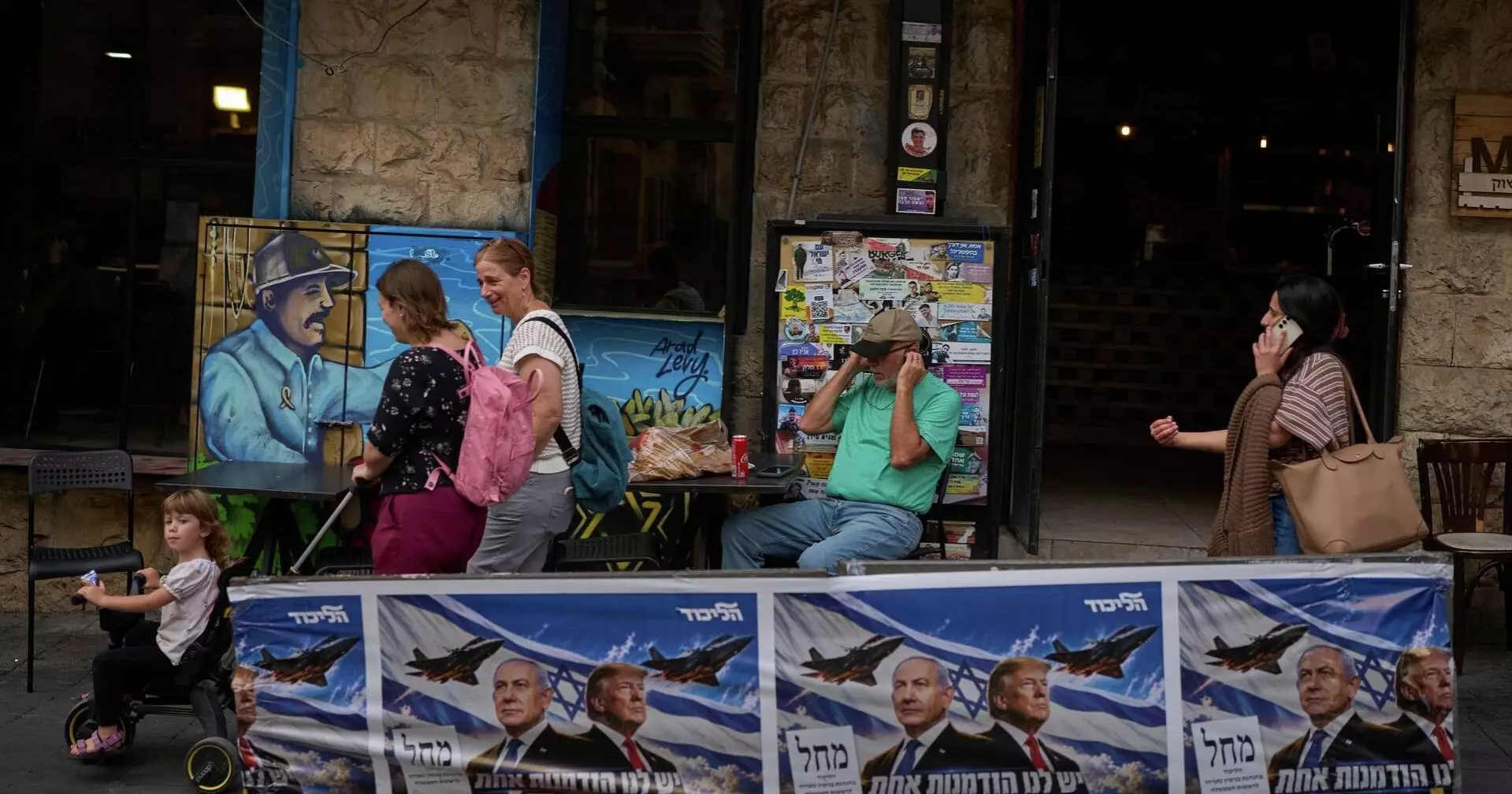
Israelis awaited final election results on Thursday amid growing indications that neither Prime Minister Benjamin Netanyahu's bloc nor the opposition parties seeking to remove him had secured a parliamentary majority.
The outcome leaves political parties facing difficult decisions, including whether Arab-led and Jewish parties will form an unprecedented alliance or whether some anti-Netanyahu parties will abandon their campaign promises and join a coalition led by the divisive prime minister. Netanyahu remains in office while negotiations unfold.
Final results could be announced as early as Thursday evening after officials count around half a million absentee ballots cast by military personnel, diplomats, prisoners, hospital patients and others. The additional votes are not expected to significantly alter the overall outcome.
Local media projections put Netanyahu's bloc at 53 seats in the 120-member Knesset, compared with 48 for opposition parties and 19 for Arab-led parties, which also oppose his continued leadership.
Opposition considers cooperation with Arab-led parties
Former military chief Gadi Eisenkot, Netanyahu's main challenger, said in his first public statement after addressing supporters early Wednesday that the country needed a government serving all citizens and reflecting the people's will.
Although Eisenkot did not directly address the possibility of cooperating with Arab-led parties, he has previously indicated that he would consider working with them to secure the 61 seats required for a parliamentary majority.
The Arab-led Joint List welcomed its strong electoral performance late Wednesday, describing it as an unprecedented show of support and praising Jewish voters who opposed racism. The alliance said it was open to political cooperation.
Small rallies supporting a coalition that includes Arab-led parties took place overnight in Tel Aviv and Jerusalem. No Arab party had joined an Israeli governing coalition before 2021, when such an arrangement briefly took place.
Despite its strong electoral showing, Netanyahu's Likud party accused Arab-led parties of stealing the election and asked the election committee to investigate. The party did not provide specific evidence for its allegations. Election officials said relatively few irregularities had been reported during the largely peaceful vote.
President Isaac Herzog is expected to ask a politician to form the next government next week. Although the leader of the party receiving the most votes has traditionally been given the task, there is no legal requirement that the nominee must lead the largest party.
If repeated attempts to form a government fail, Israel could hold another election early next year. Herzog and Eisenkot have both indicated that they want to avoid another vote.
A fresh election would raise questions about whether Arab citizens would participate in large numbers again and whether tens of thousands of Israelis who returned from abroad to vote would make another trip. Many said they had returned to prevent Netanyahu from remaining in power.
Deep divisions and security concerns shape political future
Israel entered the election deeply divided along religious, ethnic and political lines, with several major national issues at stake.
One key challenge is whether the country's rapidly growing ultra-Orthodox population should continue to receive exemptions from compulsory military service. The issue has become increasingly contentious after three years of inconclusive wars in which many Israeli families have lost sons and daughters.
Netanyahu, Israel's longest-serving prime minister, remains a polarising figure. He faces corruption allegations and accusations that he delayed agreements related to the Gaza war, including arrangements to release hostages, for political reasons.
Although security concerns were a major factor for many voters, Israel's international standing is also at stake following widespread criticism of its treatment of Palestinians in Gaza and increasing violence by Jewish settlers in the occupied West Bank.
Arab citizens, who make up around 20% of Israel's population, are cautiously hopeful that the election could bring greater political representation and improvements in their rights.
"God willing, we will have something for us in the government, something that will bring us our rights," said Brosli Elias, a resident of Nazareth, one of Israel's largest Arab cities.
Meanwhile, the possibility of renewed military strikes against Iran has added another layer of uncertainty. The Trump administration has discussed potential attacks after the Nov 3 US midterm elections.
Analysts say Netanyahu could use a renewed full-scale conflict to push for a national unity government under his leadership.
Such a development could also delay a public inquiry into the security failures surrounding the Hamas-led attack on Israel on Oct 7, 2023, the deadliest attack in the country's history, which triggered the war in Gaza.