Israel's national election produced no clear winner, according to exit polls, as votes continued to be counted early Wednesday, raising the prospect of weeks of negotiations to form a governing coalition.
The inconclusive outcome leaves Prime Minister Benjamin Netanyahu in place as caretaker head of government while political parties attempt to secure the parliamentary majority needed to establish a new administration.
Exit polls released by major Israeli television stations after voting ended on Tuesday and revised overnight indicated that neither Netanyahu's political bloc nor the alliance led by former military chief Gadi Eisenkot had secured the 61 seats required for a majority in the 120-member Knesset.
Israeli voters elect political parties rather than a prime minister directly, and parties must form alliances to achieve a parliamentary majority. No single party has ever won an outright majority.
The election took place amid deep divisions over Netanyahu's leadership and the continuing impact of the Hamas-led October 7, 2023, attack on Israel and the subsequent wars across the Middle East.
60% of votes counted
Official figures released by Israel's Central Elections Committee on Wednesday morning showed Netanyahu's Likud party leading with 21.4% of the vote, followed by Eisenkot's Yashar party with 16.2%, with 60% of ballots counted.
The figures did not yet establish how many parliamentary seats each party would ultimately secure.
Strong Arab vote raises coalition questions
The strong performance of Arab-led parties has emerged as a significant factor in the post-election political debate, as their support could prove decisive in forming a government.
An analysis published by the left-leaning Haaretz newspaper described the outcome as a test for political groups that identify themselves as democratic.
It warned that excluding Arab citizens from political participation despite their efforts to engage in the democratic process could undermine the future of the bloc presenting itself as democratic.
President to choose government formation candidate
President Isaac Herzog is expected to select the politician he believes has the best chance of forming a government. Although the presidency is largely ceremonial, the role becomes significant during coalition negotiations.
The leader of the party winning the most votes is usually given the opportunity to form a government, although Herzog is not legally required to appoint Netanyahu even if Likud finishes first.
Given the divisions surrounding Netanyahu's government, some Israelis may favour an alternative candidate during the coalition-building process.
Military turnout reaches nearly 80%
Israel's military reported a voter turnout of 79.9% among its personnel, more than six percentage points higher than in the previous election.
Hundreds of thousands of ballots cast by military personnel were still awaiting counting. Some polling stations had been established in combat zones.
Attack outside Israeli Embassy in Serbia
Separately, Serbian police said an unidentified attacker armed with two knives assaulted a security guard outside Israel's Embassy in Belgrade early Wednesday and was shot dead.
Interior Minister Ivica Dacic described the incident as a terrorist attack. Authorities raised the terror threat to its highest level and increased security at key locations.
Dacic said the attacker was a minor who shouted “Allahu Akbar,” an Arabic phrase meaning “God is great,” during the assault. The police officer shot the assailant in self-defence and sustained minor injuries, he added.
Trump says Netanyahu performed well
US President Donald Trump rejected suggestions that Netanyahu was heading towards defeat, saying he had heard that the Israeli leader had performed well.
Speaking to reporters at Joint Base Andrews in Maryland on Wednesday after returning from campaign rallies in Texas, Trump said it was too early to draw firm conclusions. He added that he had not yet spoken with Netanyahu about the results.
Trump endorsed Netanyahu late in the election campaign, while Netanyahu highlighted his close relationship with the White House in his election-night address.
Netanyahu rules out government dependent on Arab parties
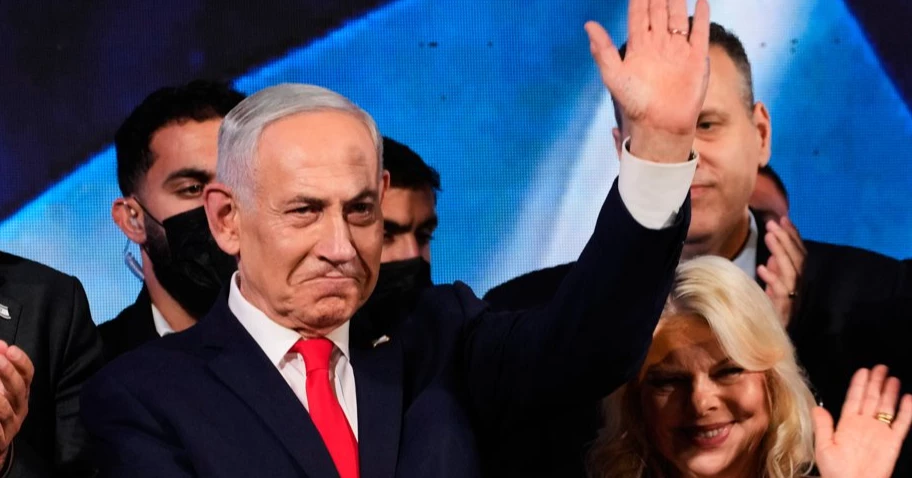
Addressing enthusiastic supporters in Jerusalem after 3am Wednesday, Netanyahu said exit polls suggested Likud would emerge as the largest party in the next parliament.
He highlighted Israel's military achievements over the previous three years and pledged to complete the campaign against Iran's government.
Netanyahu also declared that no government should be formed with the support of Arab parties. Their strong electoral performance could make them influential in coalition negotiations if the two main political blocs remain unable to secure a majority.
Both camps celebrate despite uncertain outcome
Supporters at the headquarters of both Netanyahu and Eisenkot celebrated despite the inconclusive exit polls, reflecting the uncertainty surrounding the next government's formation.
Speaking in Tel Aviv early Wednesday, Eisenkot emphasised national unity and pledged to form a government, promising Israelis “a new era — an era of hope.”
“Today, Israel went out to a referendum over the leadership that will lead Israel in the coming years,” he told cheering supporters. “The people decided in favour of change.”
Editorial note: The source contains several election-specific claims and developing figures. Verify the date, party names, official vote count and attribution before publication.