
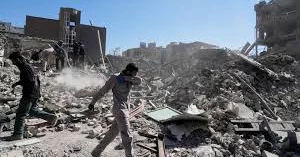
The United States and Israel launched fresh airstrikes on Tehran and other Iranian cities Wednesday, marking the fifth consecutive day of fighting, as Iran retaliated with waves of missiles and drones targeting Israel and sites across the region.
Residents of the Iranian capital awoke to explosions at dawn, with state television airing images of heavily damaged buildings in central Tehran. The holy city of Qom and several other urban centers were also struck.
Israeli warplanes were reported overhead as anxious residents watched the skies. A shopkeeper, speaking anonymously out of fear of repercussions, said he was torn between fleeing and staying to earn a living. He also voiced concern that broader regional involvement could worsen the conflict.
Israel’s military said one of its F-35 fighter jets downed an Iranian Air Force YAK-130 aircraft over Tehran. Air defenses were also activated across Israel to intercept incoming Iranian missiles, with blasts heard near Jerusalem.
Oil markets and US facilities under threat
With Iran controlling access to the Strait of Hormuz — a key route for roughly 20% of global oil shipments — Brent crude surged above $84 a barrel, rising more than 15% since the conflict began and reaching its highest level since July 2024. Markets worldwide have reacted sharply amid fears that soaring energy costs could hurt economic growth.
Drone attacks targeted the U.S. Embassy in Saudi Arabia and the U.S. Consulate in the United Arab Emirates on Tuesday. The State Department on Wednesday authorized the departure of non-essential personnel from Saudi Arabia.
U.S. Central Command chief Adm. Brad Cooper said Iran has launched more than 500 ballistic missiles and 2,000 drones since hostilities began. He described the initial U.S. strikes as nearly twice the scale of the opening phase of the 2003 Iraq invasion. According to Cooper, nearly 2,000 targets have been hit so far, significantly weakening Iran’s air defenses and missile infrastructure.
Nearly 800 people have reportedly been killed in Iran since the fighting began. U.S. President Donald Trump has suggested the conflict could last weeks and said some of those killed had once been seen as potential future leaders of Iran.
Conflict spreads across the region
Air raid sirens sounded in Bahrain, home to the U.S. Navy’s 5th Fleet, while Qatar said two Iranian ballistic missiles were fired toward its territory, with one striking Al-Udeid Air Base without causing casualties.
In Lebanon, Israeli strikes killed at least five people in Baalbek, according to state media, as Israel said it was responding to rocket fire from Hezbollah. Lebanese health officials report more than 50 dead and over 300 wounded.
Iran-linked militias in Iraq have also stepped up attacks. Saraya Awliya al-Dam claimed responsibility for a drone strike on Jordan and for previous attacks on U.S. targets in Baghdad and Irbil.
Iran has continued to launch missile and drone salvos at Israel, though Israeli defenses have intercepted most incoming projectiles. Eleven people have been killed in Israel since the war began.
Leadership succession in focus
Early joint U.S.-Israeli strikes killed Iran’s Supreme Leader Ayatollah Ali Khamenei, prompting speculation over succession. Although President Trump initially urged Iranians to rise up, senior U.S. officials later clarified that regime change was not the stated objective.
Israel’s defense minister warned that whoever is chosen as Iran’s next supreme leader could face assassination threats. Israeli forces also said they struck facilities in Tehran linked to the Basij militia, part of Iran’s Revolutionary Guard, which led a deadly crackdown on protesters earlier this year.
Iran’s judiciary chief warned that anyone aligning with the U.S.-Israeli campaign would be treated as an enemy under wartime conditions.
Iran’s leadership is now working to appoint a successor — only the second such transition since the 1979 Islamic Revolution. Among the figures reportedly under consideration is Mojtaba Khamenei, son of the late supreme leader.
Israeli officials said they targeted a building in Qom believed to be associated with clerics discussing the selection process. Iranian media denied that a meeting was underway at the time, saying members of the Assembly of Experts were convening remotely.
Mounting casualties
Iran’s Red Crescent Society said at least 787 people have been killed in U.S.-Israeli strikes. Casualties have also been reported elsewhere in the Gulf: Kuwait confirmed the death of an 11-year-old girl from falling debris during an interception, while three people were killed in the United Arab Emirates and one in Bahrain.
Six U.S. Army Reserve soldiers were killed Sunday in a drone attack on a command center in Kuwait’s Port Shuaiba.
With neither side signaling a pause, questions remain over how and when the expanding conflict will end.