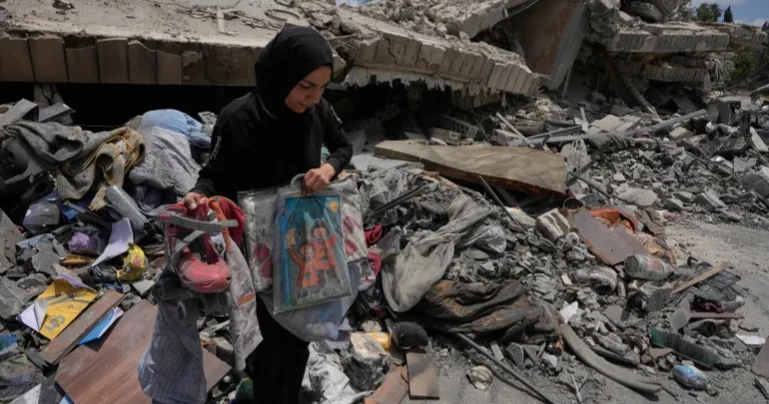
Israeli troops opened fire in southern Lebanon on Tuesday, killing two people and injuring two others, according to Lebanon's state-run National News Agency (NNA), in the first reported fatalities from Israeli fire in three days under a fragile US-brokered ceasefire.
The two men were killed in a town near the southern city of Nabatieh when Israeli soldiers opened machine-gun fire as they stood near an excavator clearing a blocked road, the NNA reported.
The incident threatens the ceasefire that has largely held since Sunday.
The Lebanese armed group Hezbollah denounced the incident as a "treacherous attack" and a "blatant" violation of the truce, though it did not indicate whether it would retaliate.
The Israeli military said it had "struck armed terrorists who posed an immediate threat" to its troops in the Ali al-Taher ridge area, located within a self-declared Israeli "security zone" in southern Lebanon.
Earlier in the day, Mahmoud Qamati, deputy head of Hezbollah's political council, warned that the group would respond to any Israeli ceasefire violation "in kind."
"Hezbollah remains fully alert with its finger on the trigger, ready to confront any violation by the Israeli regime," Iran's Press TV quoted him as saying.
Qamati also said there would be no return to the pre-war situation, when Israeli forces carried out near-daily attacks on Lebanon while Hezbollah refrained from responding.
According to reports, Israeli attacks on Lebanon have killed at least 4,106 people since March 2 and displaced more than 1.2 million others.
Israel's death toll in its latest conflict with Hezbollah includes at least 32 soldiers and four civilians.
Israeli Prime Minister Benjamin Netanyahu, Defence Minister Israel Katz and Chief of the General Staff Eyal Zamir said in a joint statement on Tuesday that the Israeli military would continue to act "with determination" to eliminate threats against its soldiers and citizens.
The statement said the military would continue to destroy Hezbollah infrastructure and maintain the security zone in southern Lebanon.
In a separate video statement, Netanyahu insisted that Israeli forces would retain "full freedom of action" in Lebanon and remain in the security zone for as long as necessary.
Meanwhile, Iranian Foreign Ministry spokesman Esmaeil Baghaei said the United States was obligated to ensure Israel halted its attacks on southern Lebanon.
"The obligation to put an end to the war in Lebanon is part and parcel of the previous and current arrangements," he said, adding that there was no justification for Israel to continue its attacks.
Baghaei described the Israel-Hezbollah conflict as a "very complicated issue" but said final arrangements could be reached in the coming days.
A new round of US-mediated talks between Israel and Lebanon is scheduled to begin in Washington on Tuesday and continue through Thursday.
Lebanon is being represented by Ambassador Nada Moawad, while Israel's delegation is led by Ambassador Yechiel Leiter. US officials are also participating in the negotiations.
Lebanon is seeking a full Israeli withdrawal from southern Lebanon, where Israeli forces have established a so-called buffer zone covering about six percent of Lebanese territory.
Israel, meanwhile, is pushing for Hezbollah's disarmament, while Hezbollah insists the talks should focus solely on mutual security issues and that its weapons should not be part of the negotiations.
Many Lebanese residents remain sceptical about the ceasefire.
Mohammed Yassin, 60, told Reuters that he would return to his home in the southern town of Hula only when authorities declared the area safe.
"We don't trust the ceasefire, because Israel is deceitful," he said.
Another resident, Suzanne, 60, said she and her family had been displaced after Israeli attacks destroyed homes in Beirut's southern suburbs, known as Dahiyeh.
"We don't have trust, because several times they've said there was a ceasefire, and then they go back to attacking again," she said.
Source: Al Jazeera