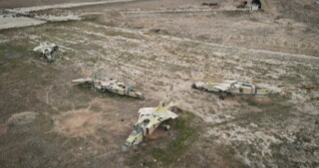
A Turkish delegation visited a Syrian air base in the northwestern province of Idlib just a day before the facility was hit by Israeli airstrikes, Syrian officials said.
The Israeli strikes targeted the Abu Duhur air base early Tuesday, causing damage but no casualties. The attack came only hours after the Turkish delegation left the site.
Israeli Prime Minister Benjamin Netanyahu's office said Israel carried out the strikes because Syria was "on the verge of breaching" an agreed security arrangement by allowing Turkish troops to deploy at the base.
Two Syrian officials, speaking anonymously because they were not authorised to comment publicly, said the Turkish delegation visited Abu Duhur on Monday to inspect rehabilitation work at the facility.
The visit was the first confirmed indication of a Turkish presence at the air base.
Neither Turkish nor Syrian officials have publicly explained Turkey's role at the facility. However, both countries condemned the Israeli strikes. US Ambassador to Turkey and special envoy to Syria Tom Barrack, along with several Arab countries, also criticised the attack.
Turkish officials did not comment on the reported military visit on Wednesday. However, Turkey's communications directorate accused Netanyahu of making claims aimed at justifying what it called Israel's unlawful attacks on Syria's sovereignty and territorial integrity.
It also accused Netanyahu of pursuing policies that could destabilise and expand Israel's influence in the region ahead of elections in Israel.
Turkey said it would continue working with the Syrian government to promote peace, stability and development in the country and would not allow Syria to be destabilised.
Strategic location
The Abu Duhur air base is located in a strategically important area near the borders of Idlib, Aleppo and Hama provinces.
Under former Syrian President Bashar Assad, who was ousted by a rebel offensive in December 2024, the base was used by MiG-23 and MiG-21 fighter jets and L-39 aircraft.
Turkey has been helping Syria rebuild its military by training Syrian personnel at Turkish military schools and bases and providing equipment and logistical support. The two countries signed an agreement last year to formalise their military cooperation, although officials have not disclosed details of the equipment supplied.
Syrian troops also participated in military exercises in Turkey earlier this year.
Turkish officials have repeatedly said that Syria's security is closely linked to Turkey's own security.
Tensions between Turkey and Israel
Israel has remained wary of Syria's new authorities, who are led by former Islamist insurgents. Syria's interim President Ahmad al-Sharaa has repeatedly said he does not want a conflict with Israel.
Israel carried out hundreds of airstrikes in Syria after Assad's fall, mainly targeting military equipment and facilities belonging to the former Syrian army.
The Israeli military also took control of a UN-patrolled buffer zone in southern Syria, where its forces remain stationed.
Turkey, a NATO member that recently signed a defence agreement with Saudi Arabia and Pakistan, has not indicated that it plans to respond militarily to the Israeli strikes.
However, the incident has added to already tense relations between Turkey and Israel.
The two countries were once close allies, but relations have deteriorated during Turkish President Recep Tayyip Erdogan's more than two decades in power, despite brief periods of improved ties.
Erdogan has strongly criticised Israel's policies toward the Palestinians, while Israel has objected to his support for Hamas.
The fall of Assad's government has further increased tensions as Turkey and Israel have sought to limit each other's influence in Syria. Some analysts have warned that the rivalry could eventually develop into a proxy conflict.