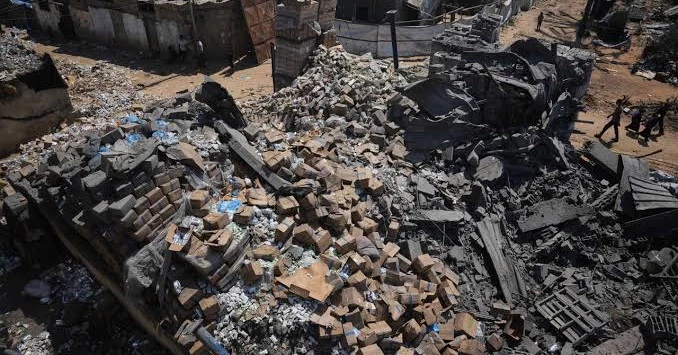
Israeli airstrikes killed five Palestinians in Gaza and three in the West Bank on Friday, despite a fragile U.S.-brokered ceasefire. At the same time, the wider Middle East continued to face the effects of the Iran war, including disruptions to shipping, new U.S. sanctions and diplomatic developments.
Israeli strikes continue in Gaza and West Bank
Two brothers and another member of the same family were killed when an Israeli strike hit their home near Khan Younis, according to officials at Nasser Hospital. Two additional Israeli attacks in Gaza City killed one person each, health officials at Shifa Hospital said.
The Israeli military confirmed carrying out strikes in Gaza but said it had no information about the attack near Khan Younis.
Gaza health officials said the five deaths bring the number of Palestinians killed in Israeli airstrikes since the October ceasefire agreement to more than 1,300.
In the West Bank city of Jenin, the Israeli military said an airstrike killed three Palestinians. The military identified one of them as Qais Bitawi, whom it accused of being involved in major militant activity, and described the other two as associates.
The Palestinian Health Ministry confirmed the deaths, while Hamas denounced the attack as a serious crime. Violence has intensified across the West Bank, with at least 87 Palestinians and three Israelis killed in attacks in 2026, according to the report.
Iran's leader calls for national unity
Iranian Supreme Leader Mojtaba Khamenei said Friday that actions that undermine national unity in political, security, cultural, social or economic areas would not be tolerated.
He warned that even proposals supported by some parts of society could cause harm if their wider social effects were ignored. He also criticized rhetoric that he said creates divisions, including debates framed as “war or negotiations” or “consensus or radicalism.”
U.S. diplomats begin returning to the region
Some American diplomats and their family members have started returning to U.S. diplomatic missions across the Middle East after being ordered to leave during the early stages of the Iran conflict.
The U.S. embassies in Doha, Kuwait City and Manama said Friday that certain family members of diplomats could return. Earlier in the week, similar arrangements were made for U.S. government employees and their families in Israel and for certain personnel in Beirut.
Iran's president says talks with the U.S. are necessary
Iranian President Masoud Pezeshkian said Tehran and Washington would not be able to achieve all of their objectives and that negotiations were necessary to restore stability.
According to Iranian state television, Pezeshkian said Iran would continue to honor the Islamabad memorandum as long as the United States also fulfilled its commitments. He said this could create a basis for further negotiations aimed at reaching a wider settlement.
He also criticized Iranian hard-liners who oppose negotiations, support prolonging the conflict and argue that international sanctions have had little impact.
Thousands of sailors remain stranded
The United Nations' maritime agency reported that 19 seafarers have died and at least 6,000 remain stranded aboard hundreds of ships since the Iran war began on Feb. 28.
The International Maritime Organization has recorded at least 70 attacks on international shipping in the Persian Gulf. Before the conflict, roughly 20% of global traded oil and natural gas traveled through the strategically important waterway at the entrance to the gulf.
Iran and Russia seek closer energy cooperation
Iran and Russia are considering reviving a plan first developed in 2022 to connect their energy networks more closely, Iranian state media reported.
The proposal could involve transporting around 55 billion cubic meters of Russian natural gas each year into Iran through Azerbaijan. Analysts say such an arrangement could help Iran deal with seasonal gas shortages and reduce the impact of U.S. economic pressure.
However, constructing the necessary infrastructure would require substantial investment and could take years.
U.S. targets Egyptian bank over Iran ties
The Trump administration is moving to restrict the operations of Banque Misr, Egypt's second-largest bank, in the United Arab Emirates.
U.S. authorities accuse the bank of helping provide an economic channel to Iran's leadership. Under a proposed Treasury Department measure, Banque Misr's UAE branches would lose access to the U.S. financial system.
Egypt's central bank said the restrictions would apply only to Banque Misr's UAE branches and dollar-related transactions. Other Egyptian banks would not be affected.
Iran's Foreign Ministry condemned the latest U.S. measures, describing them as “economic terrorism.” Tehran said the sanctions violate international law and vowed to use available means to resist them.
U.S. Treasury Secretary Scott Bessent earlier warned that Washington intended to isolate Iran from the global economy and could impose secondary sanctions on countries that continue doing business with Tehran.
UN members consider extending Lebanon peacekeeping mission
The U.N. Security Council held a closed-door meeting Friday to discuss Lebanon's request to extend the mandate of UNIFIL, the 8,100-member U.N. peacekeeping force in southern Lebanon.
Two diplomats said most of the 15 council members strongly supported extending the mission, particularly because of continued instability in Lebanon. However, there was not complete agreement.
Israel has long called for UNIFIL to be shut down, and the United States previously supported ending the mission's mandate. The situation has since changed following the latest Israel-Hezbollah conflict, which began March 2. Although a truce was reached June 20, clashes and Israeli airstrikes have continued.
U.S. Ambassador Mike Waltz attended Friday's meeting but did not indicate whether Washington would support a limited extension.
U.S. revokes former Iraqi finance minister's visa
The Trump administration has revoked the U.S. visa of Taif Sami Mohammed Al Shakarchi, Iraq's former finance minister and a recipient of the State Department's 2022 International Women of Courage Award.
The State Department said her visa was canceled after the FBI placed her on its terrorism watchlist. Iraqi authorities had previously linked her to a possible corruption investigation.
It remains unclear why she was placed on the watchlist. U.S. officials said she had already left the country before her visa was revoked.