Deadly Israeli airstrikes in Gaza on Wednesday cast fresh doubt on whether renewed US diplomatic efforts can advance a fragile ceasefire in the Palestinian territory.
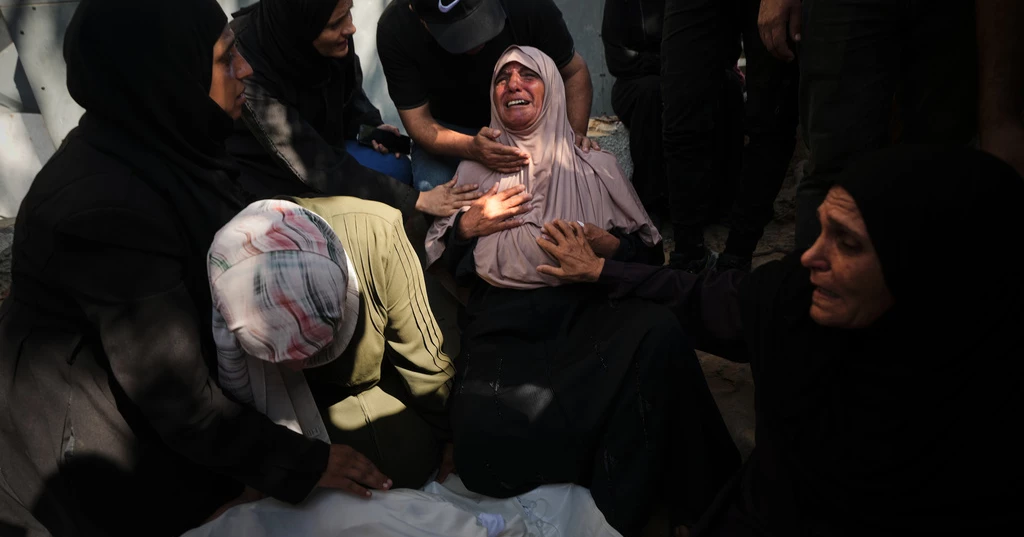
Just two days after US negotiators reportedly urged Israel to scale back attacks in Gaza, at least 10 people were killed in two strikes on Wednesday, according to local hospitals and the Palestinian Red Crescent.
Israeli troops also crossed the ceasefire line in southern Gaza and detained a Hamas police colonel early Wednesday, according to two witnesses and a Hamas official.
The Israeli military said one of Wednesday's strikes in the Nuseirat refugee camp area targeted a Hamas commander who participated in the group's Oct. 7, 2023, attack on southern Israel. The attack killed about 1,200 people, mostly civilians, and saw 251 others abducted.
A second strike in Gaza City's Tuffah area targeted four Hamas militants gathered at a police station, the military said, claiming they were planning attacks against Israeli troops.
The military also said a strike the previous day targeted a meeting of four Hamas commanders and other militants.
It identified those killed as Muhammad Hamdi Ahmad Al-Masri, Muhammad Attar and Muhammad Fathi Hussein Nasser, whom it accused of carrying out attacks against Israeli troops, and Samed Samir Harb Abu Habal, who it said infiltrated Israeli territory during the Oct. 7 attack.
The Hamas-run Interior Ministry said Wednesday's strike on the police station in Gaza City killed eight police officers and a 13-year-old girl. Two of the officers were women. Another person was killed in Nuseirat.
On Tuesday evening, an Israeli strike on a crowded seaside cafe killed seven Palestinians, including a child, according to Gaza's Health Ministry.
Jared Kushner, a US negotiator and son-in-law of President Donald Trump, held a lengthy meeting with Israeli Prime Minister Benjamin Netanyahu on Monday and asked him to reduce attacks on Gaza, according to a person familiar with the meeting.
The person spoke on condition of anonymity because they were not authorized to brief journalists.
The Israeli military also said Wednesday it had completed reviews of 150 incidents involving the conduct of its troops during the Gaza war. It said criminal investigations would be launched into the 2024 deaths of a 5-year-old girl and her family, as well as the 2025 killing of 15 Palestinian paramedics.
At least 17 killed in Israeli strikes
The latest casualties from Israeli strikes on Tuesday and Wednesday came despite a ceasefire that has been in place since October and has significantly reduced fighting in the densely populated territory, where more than 2 million Palestinians live.
Since the ceasefire began, Israeli strikes have killed at least 1,273 people, according to Gaza health officials.
The nearly three-year Israel-Hamas war has killed more than 73,400 Palestinians, according to Gaza's Health Ministry. The ministry, which was part of the recently dissolved Hamas-run government, maintains detailed records generally considered reliable by UN agencies and international organizations.
The ministry does not distinguish between civilians and militants but says women and children account for about half of the deaths.
Early Wednesday, at least 15 Israeli troops entered the Muwasi coastal area west of Khan Younis, according to two residents and a Hamas official.
The troops, accompanied by armed men, raided the tent of Sabri Abdel-All, a colonel with the Hamas-led Blue Police in Khan Younis. They also detained another resident, identified as Nashat Ezzat Zaarab, the sources said.
The residents and the Hamas official spoke on condition of anonymity for their safety.
Latest ceasefire talks offer few concrete commitments
Diplomatic efforts to strengthen the ceasefire also appear to have stalled.
Trump's initial ceasefire proposal outlined a broad vision for ending Hamas' rule in Gaza and rebuilding the territory, much of which has been devastated by the war.
But major disagreements have emerged since last fall over Hamas' disarmament and Israel's withdrawal from Gaza, including which step should come first.
Earlier this month, Trump said Hamas had agreed to disarm. Hamas, however, said it would begin disarming only if Israel stops its strikes and withdraws from Gaza. It said giving up heavy weapons would come later and depend on the establishment of a Palestinian state, a condition rejected by Israel's government.
Netanyahu has also rejected the arrangement, saying Israel will not withdraw from its current positions in Gaza until Hamas is completely disarmed.
Following Wednesday's strikes, Hamas spokesperson Hazem Qassem criticized the Board of Peace, the body established by Trump to oversee the ceasefire. He accused it of providing a “cover” for Israel to escalate attacks in Gaza instead of pressuring Israel to comply with the ceasefire agreement.