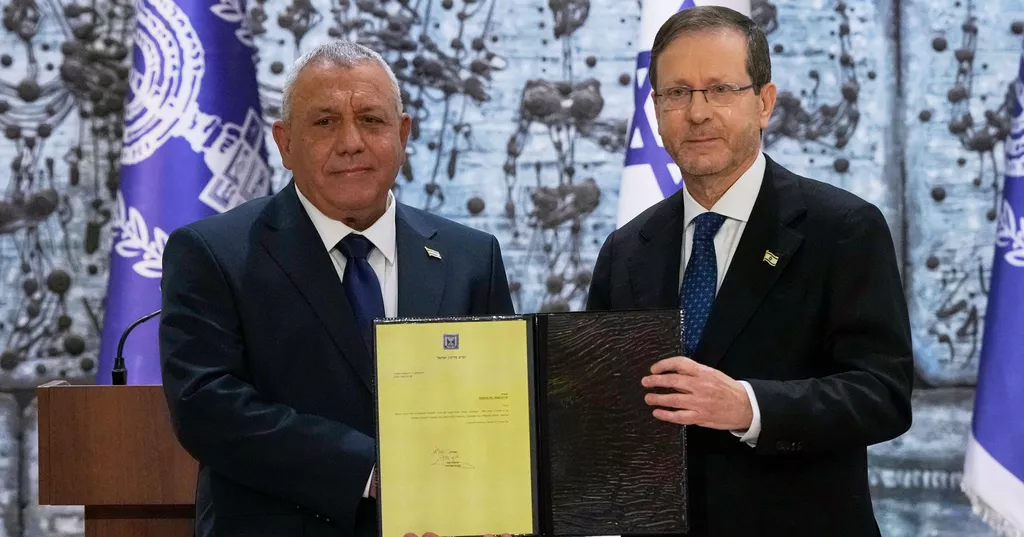
Israeli President Isaac Herzog on Sunday formally tasked opposition politician Gadi Eisenkot with forming the country's next government, giving him the first opportunity to replace long-serving Prime Minister Benjamin Netanyahu.
The move marks a significant step in Eisenkot's efforts to take power following the October 27 election, although difficult coalition negotiations lie ahead in a deeply divided country still grappling with the aftermath of the Hamas-led October 7, 2023 attacks and the multiple wars that followed.
Speaking at a ceremony at the presidential residence in Jerusalem, Herzog expressed hope that the next government would promote national unity and help heal divisions across Israeli society.
He said the country's survival depended on bringing together all segments of the population.
However, the appointment does not guarantee that Eisenkot, a former army chief, will become prime minister. He has up to six weeks to secure the support of political parties and form a coalition, as the election failed to give either his bloc or Netanyahu's camp a clear parliamentary majority.
Herzog said a majority of members of the Knesset, Israel's parliament, had backed Eisenkot during consultations with political parties.
At the ceremony, Eisenkot pledged to provide trustworthy leadership that would serve the public interest and represent all sections of society.
He said an overwhelming majority of lawmakers representing the Israeli public supported political change, adding that he would approach the challenge with patience, humility and a commitment to building a Jewish, equal, liberal and secure Israel.
Coalition negotiations pose difficult political choices
The Arab-led parties, which made significant gains in the election following strong turnout among Arab citizens of Israel, could play a decisive role in determining the next government.
Only one Arab party, Ra'am, has previously joined an Israeli governing coalition, doing so in 2021. The party has pledged to support Eisenkot, but its parliamentary strength alone is insufficient to give him a majority.
In a departure from decades of political practice, another Arab-led party, the Joint List, has offered to support Eisenkot's government from outside the coalition in an effort to end Netanyahu's hold on power.
However, such cooperation presents difficulties for both sides. The Joint List would be backing a government that may not end Israel's wars or halt settlement expansion in the occupied West Bank.
For Eisenkot and his opposition partners, cooperation would mean relying on parties that strongly criticise Israeli policies and oppose the country's definition as a Jewish state.
One of Eisenkot's political partners, the conservative Yisrael Beytenu party, has already ruled out joining a government that includes Arab-led parties.
Eisenkot has set four conditions for parties seeking to join his coalition. They must recognise Israel as a Jewish and democratic state, accept its declaration of independence, support military, national or civilian service for all citizens, and designate Hamas as a terrorist organisation.
It remains uncertain whether the potential Arab partners will agree to these conditions.
Meanwhile, Netanyahu has repeatedly made unsubstantiated allegations that Arab parties "stole" the election and warned Eisenkot that forming an alliance with them would amount to betrayal.
Israel's Shin Bet security agency has launched an investigation into possible foreign interference in the election. However, the Central Elections Committee and Herzog have maintained that the vote was valid, saying that even if irregularities are established, they did not significantly affect the results.
Eisenkot faces major hurdles in forming a coalition
Eisenkot has pledged to form a government as quickly as possible, but the available options involve difficult political compromises.
Apart from seeking support from Arab-led parties, he could consider a power-sharing arrangement with Netanyahu or negotiate with ultra-Orthodox parties that want to retain military service exemptions for their communities.
Equal military service was a major campaign pledge for Eisenkot and his partners, who have called for an end to the longstanding exemptions.
The ultra-Orthodox parties, which were part of Netanyahu's outgoing coalition, want to preserve the exemptions, arguing that they are essential to their religious way of life.
The issue has become increasingly contentious among the wider Israeli public during the past three years of war.
The ultra-Orthodox party United Torah Judaism, aware that its support could be decisive in the coalition negotiations, has kept open the possibility of cooperating with Eisenkot.
Under the constitutional process, Eisenkot has 28 days to form a government, with a possible two-week extension from the president.
If he fails, Netanyahu could be given another opportunity to assemble a coalition. Should he also fail, Israel would return to the polls early next spring.
The newly elected members of the Knesset are scheduled to be sworn in on Tuesday evening. Netanyahu and his cabinet will continue in a caretaker capacity with limited powers until a new coalition government is formed.
Wars and international support await next government
The next Israeli government will also face major security and diplomatic challenges.
Despite ceasefires, Israeli forces remain engaged in fighting Hamas militants in Gaza and Iran-backed Hezbollah militants in Lebanon. The war launched by Israel and the United States against Iran also remains unresolved.
Both Herzog and Eisenkot highlighted these challenges on Sunday, along with what the president described as the changing political situation in the United States, where the recent midterm elections indicated weakening support for Israel among both Democrats and Republicans.
Herzog urged Eisenkot to draw on his military leadership experience and personal loss, including the death of his son in combat in Gaza, to help unite the country.
Recalling Eisenkot's years of military service, Herzog said he had commanded soldiers from different backgrounds across Israeli society and bore the physical scars of decades of military leadership and combat.
He urged Eisenkot to remember, during the coming coalition negotiations, that the entire nation was looking to him with its pain, hopes, prayers and fears.