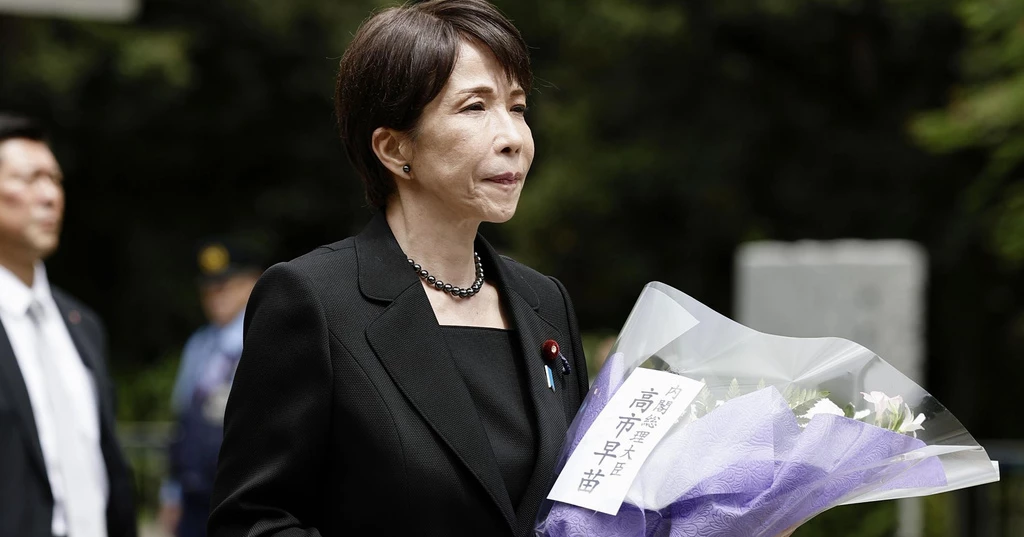
Japanese Prime Minister Sanae Takaichi stayed away from Tokyo’s controversial Yasukuni Shrine on Saturday as Japan marked the 81st anniversary of its surrender in World War II, apparently seeking to avoid further tensions with China and South Korea.
However, in her address marking the anniversary, Takaichi did not refer to Japan’s wartime aggression in Asia or express remorse for atrocities committed during the war.
She paid tribute to those who died in the devastation of Hiroshima, Nagasaki and Okinawa, as well as Japanese troops who died on overseas battlefields, describing their sacrifice as the foundation of Japan’s peace and prosperity.
“Japan, since the end of the war, has consistently contributed to global peace and prosperity. We will never let the tragedy of the war be repeated,” she said, stressing that Japan could play an important role in addressing regional and global challenges as a reliable nation.
Defense Minister Shinjiro Koizumi, another Cabinet minister and three senior officials of Takaichi’s governing Liberal Democratic Party visited Yasukuni Shrine earlier Saturday.
The shrine honours Japan’s war dead, including 14 convicted Class-A war criminals, and visits by Japanese political leaders have long drawn strong criticism from China and South Korea, which regard them as signs that Japan has failed to properly confront its wartime past.
China’s Foreign Ministry lodged a protest with Japan over the shrine visits, accusing Japanese politicians of attempting to revise the historical judgment on wartime criminals, conceal Japan’s wartime atrocities and distort historical facts. Beijing called on Tokyo to seriously reflect on its wartime history and abandon militarism.
Relations between Japan and China have been strained since November, when Takaichi said a Chinese attack on Taiwan could create a situation threatening Japan’s survival and potentially require Tokyo to use force.
South Korean President Lee Jae Myung said Saturday that Seoul would continue pursuing pragmatic diplomacy based on national interests while expanding cooperation with Japan.
“Korea-Japan cooperation is now more important than ever,” he said, adding that the new bilateral relationship should also recognise those still suffering from historical grievances.
Takaichi had repeatedly said she would visit Yasukuni on Aug. 15, making her decision to stay away closely watched.
Koizumi, who has regularly visited Yasukuni on the anniversary of Japan’s wartime surrender, made the visit despite his position as defense minister in a government seeking to strengthen Japan’s military capabilities and expand weapons exports. He did not comment on the visit and walked past reporters at the shrine.
Three senior LDP officials also prayed at the shrine and made offerings on behalf of Takaichi. Party Secretary-General Shunichi Suzuki said he offered prayers with the prime minister’s thoughts for the spirits of the war dead in mind.
The move was also seen as an attempt to maintain Takaichi’s support among conservative and right-wing voters despite her decision not to visit personally.
Japanese Emperor Naruhito, meanwhile, struck a different tone in his address at a memorial ceremony in Tokyo. He expressed hope that the devastation of war would never be repeated and referred to the need to reflect on Japan’s past while keeping in mind feelings of deep remorse.
Naruhito also called for the memories of suffering during and after the war to be passed on to future generations.
Takaichi has previously resisted acknowledging Japan’s wartime aggression and has rejected calls for an apology over issues including forced labour and the exploitation of women as sex slaves for Japanese troops.
She has said that she belongs to a postwar generation and bears no responsibility for Japan’s wartime actions.
Her position is in line with a broader nationalist trend in Japan associated with former Prime Minister Shinzo Abe, whom Takaichi has regarded as a political mentor.
Since Abe’s government, Japanese prime ministers have largely avoided new apologies to Asian victims of Japan’s wartime atrocities. Former Prime Minister Shigeru Ishiba, however, expressed remorse over the war and described it as a mistake last year.