Jordan and Syria have agreed to form a joint committee to investigate Jordanian airstrikes that killed several civilians in Syria, raising tensions between the neighbouring countries.
Jordan said on Tuesday that its airstrikes in Syria killed around 20 militants of the extremist Islamic State (IS) group, while acknowledging that civilians were also killed. Syrian authorities reported seven deaths, most of them women and children.
In a joint statement issued after a telephone conversation between the two countries' foreign ministers, the sides said they would “develop mechanisms for field and intelligence coordination to deal with terrorist threats in a manner that ensures the preservation of Syrian sovereignty and the protection of the lives of innocent civilians.”
Jordan's air force launched the strikes on Monday evening in retaliation for last week's attack on a funeral at a Greek Orthodox church in the southern Jordanian city of Karak, which killed nine people. Earlier on Monday, Jordan announced the arrest of three gunmen in connection with the attack but did not disclose their affiliation.
The death toll provided by Jordanian government spokesperson Mohammad al-Momani differed from figures reported by Syrian emergency responders.
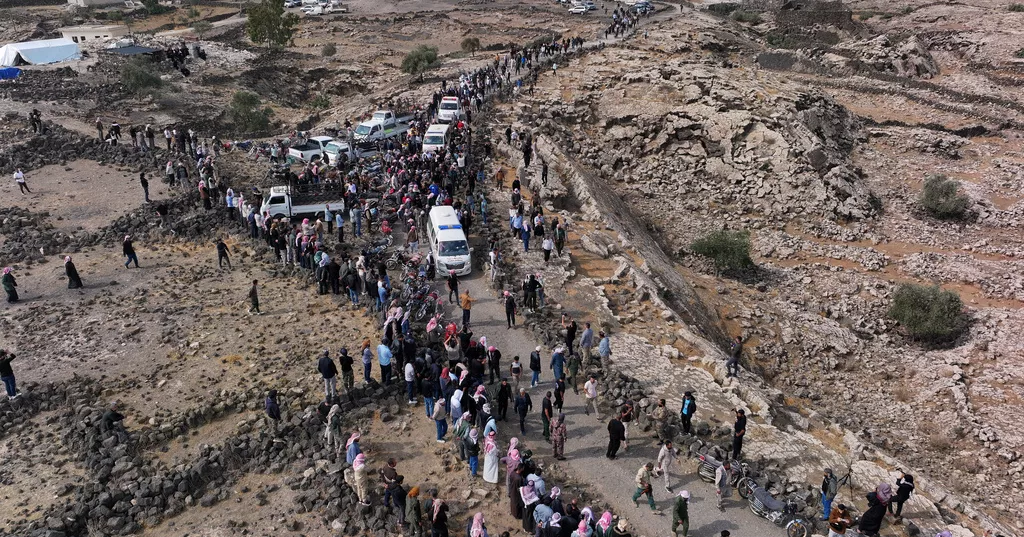
Syria's civil defence authorities said they had recovered the bodies of seven civilians killed in the strikes in the southern provinces of Daraa and Sweida. Five of the victims belonged to the same family, including three children and a woman, while two other victims were elderly men.
The Syrian government said the strikes were carried out without prior coordination or notification. Both Damascus and Amman said they were in contact and following up on the incident.
In a statement, Syria's Foreign Ministry condemned the attacks as an “unacceptable violation and encroachment” of Syrian airspace. However, it also said the leaderships of both countries would strengthen security coordination to “obstruct any efforts to destabilize the two countries' security and spill the blood of its people.”
Al-Momani said the strikes were based on intelligence indicating “confirmed threats and planned terrorist acts against Jordan”. He also expressed regret over the civilian casualties.
Jordan and Syria have maintained strong bilateral relations since the fall of the Assad dynasty in December 2024 and the emergence of an Islamist-led government under interim President Ahmad al-Sharaa.
Masoud al-Salim lost his wife, son and three grandchildren when one of the strikes hit his home in the Syrian border village of Al-Tuff in Daraa province.
“I came running and found there was no house anymore, no tent, nothing. I couldn't find anyone,” al-Salim said as he searched through children's schoolbooks and toys scattered in the rubble.
“I started looking under the rubble. I thought they might be buried there,” he said.
At the funeral of the family killed in Monday's strikes, mourners struggled to come to terms with their loss.
“When the church in Karak was targeted, we felt sorry for them and were upset for them,” said Majed al-Hayjan, a resident of Daraa.
“But what did the children who were sleeping have to do with this? We had to pull them out from under the rubble. What did they do to deserve this?” he said.