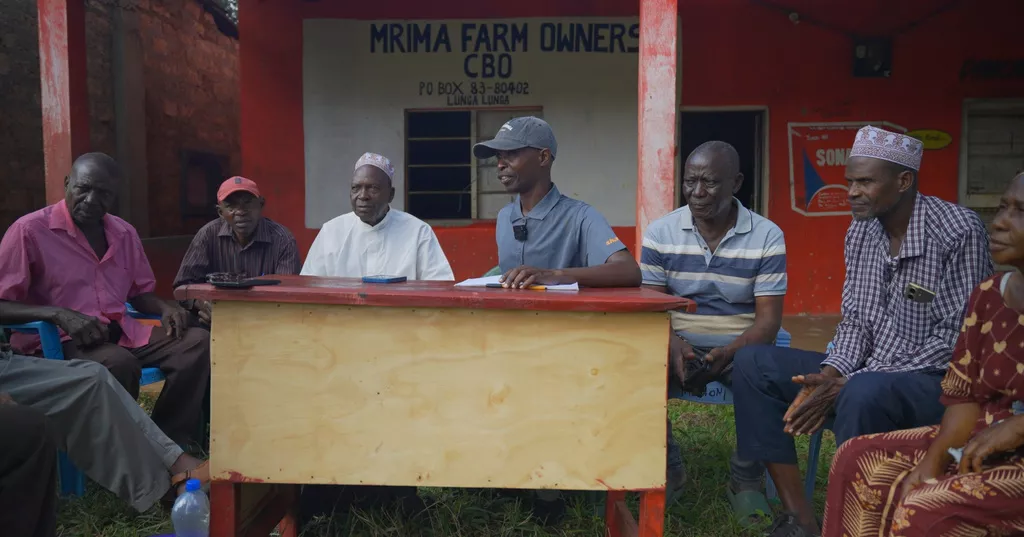
Plans to extract valuable minerals from Kenya's forested Mrima Hill have raised concerns among local farmers and community elders, who fear losing their farmland, livelihoods and a sacred forest where their ancestors are buried.
The proposed mining project comes as countries around the world compete to secure supplies of rare earth elements and other critical minerals used in electric vehicle motors, wind turbines and defence technologies, while seeking to reduce dependence on China for mineral processing.
Residents near Kenya's Indian Ocean coast, close to the Tanzanian border, say they have received little information about the proposed mining activities, including where extraction would take place and how the project could affect their livelihoods and cultural heritage.
"We haven't been informed about the process at all," said Justus Mwero, chairman of the Mrima Farm Owners Community-Based Organization, which has around 500 registered farmers.
"We don't know how people are going to be looked after, or what impact the project will have," he said.
At a recent gathering beside the main road in Mrima, farmers discussed the proposed development as the forested hill stood across the road.
"We are waiting to see what is going to happen," Mwero said.
Kenya seeks to expand mining sector
Kenya's Mining Minister Hassan Joho told The Associated Press earlier this week that a technical committee was evaluating five proposals for the project, with an announcement expected within two to three weeks.
The ministry has not disclosed the nationalities of the bidders, citing confidentiality.
However, Australian company RareX said its consortium with another Australian company, Iluka Resources, submitted a technical and financial proposal on October 21.
Nasdaq-listed Critical Metals Corp. also announced in July that its consortium had been shortlisted for the final bidding stage for the development of the Mrima Hill rare earth and niobium project.
In an interview with US-based news outlet Semafor on September 28, Joho said the government considers mining and local mineral processing important for economic expansion and employment generation.
He said Kenya aims to increase the mining sector's contribution to gross domestic product from around 1% to 10% within the next decade.
According to mining news website Extractives Daily, projections made in 2013 estimated that the project could generate gross revenue of around $62 billion over 23 years.
The estimate was based on commodity prices at the time, excluded development and operating costs and did not indicate how much revenue would go to the Kenyan government.
Sacred forest raises cultural concerns
For members of the local Digo community, however, Mrima Hill holds significance beyond its mineral resources.
The area contains a sacred forest, known as a kaya, where community members say their ancestors are buried.
"Our traditions and practices are organized around the forest," said Masoud Suleiman Mwarizo, chairman of the Mrima Hill Digo Community Trust, established in 2025 to protect the community's interests in the project.
"All our ancestors are buried here. We will refuse any digging of the hill," he said.
The Mrima Hill Sacred Grove forest reserve was declared a national monument in 1992.
The National Museums of Kenya did not respond to a request for comment.
Farmers fear displacement and environmental damage
Farmers living around the hill are concerned that possible relocation could force them onto less fertile land, although it remains unclear whether the proposed project would require residents to move.
"We all rely on farming to survive. This land is fertile, and if we are relocated to less fertile land, hunger could strike us," Mwero said.
Rama Bindo, treasurer of the Digo Community Trust, said farmers without formal land ownership documents could be particularly vulnerable to losing their property.
"Not all farmers have title deeds to prove ownership of their land, and that makes it easy for land grabbing to happen," Bindo said.
Mining Minister Joho told the AP that the ministry had consulted the local community before advertising the tender for the development of Mrima Hill.
He said that after selecting the successful bidder, the ministry would formally introduce the company to residents to allow them to reach agreements.
Under Kenya's Mining Act, a company holding a mining licence must sign a community development agreement with the community where the mining operation is located. It cannot begin extraction until landowners have received compensation.
Harry Kimtai, principal secretary at the Mining Ministry, said that once a company is selected, communities would be encouraged to engage directly with the successful bidder.
He added that the government would explain residents' rights in case of disputes and monitor whether the company complies with the law.
Legal challenge over proposed mining agreement
The Centre for Litigation Trust, a Kenyan civil society organisation, has challenged a proposed agreement between Kenya and the United States to develop the minerals at Mrima Hill. Details of the agreement have not been made public.
In a petition filed on June 22, the organisation said it had asked the High Court in the coastal town of Kwale to suspend the agreement until local residents and their representatives were consulted.
It argued that the bidding process lacked transparency and adequate public participation.
The government has not publicly clarified how the proposed Kenya-US agreement relates to the current tender process.
According to the organisation's lawyer, Kenya's attorney general challenged the court's jurisdiction.
The group said the court was scheduled to deliver a ruling on the objection on November 6, adding that no court order currently prevents implementation of the agreement.
Meanwhile, local residents and advocacy groups are seeking information about the proposed mineral extraction methods and their possible environmental and health consequences.
"We don't know anything about the extraction method. Will it be open-pit mining, and what will be the impact on the environment and on health?" said Fakii Omar of the Kwale Mining Alliance, an advocacy organisation representing communities affected by mining activities.
The National Environment Management Authority did not respond to questions from the AP regarding environmental assessments, public consultation and the approval process.
RareX said its consortium's proposal included securing community support before mining begins and protecting local residents, the environment and cultural heritage.
The company also said it had proposed further studies to determine whether the mineral deposit could be developed through underground mining.
Mwero said local residents wanted to participate in decisions concerning the future of their land.
"We want an open forum to discuss our concerns. We are the custodians of this land, and we should be the ones negotiating over it," he said.