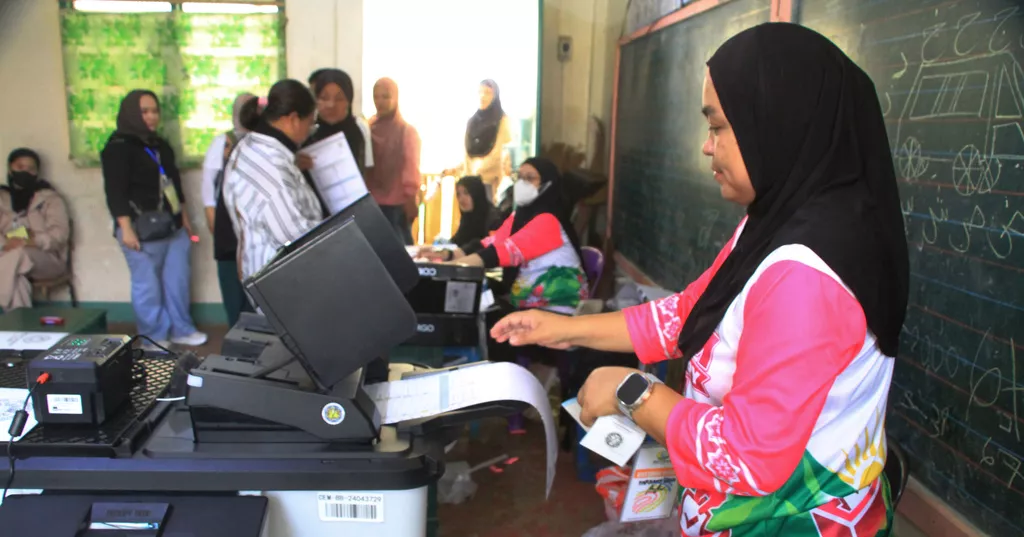
A predominantly Muslim region in the southern Philippines held its first elections for a regional parliament on Monday and Tuesday after years of delays, bringing it closer to self-rule following decades of insurgency and violence.
Officials said voter turnout exceeded 80%, although five people were killed in election-related violence in the regional capital. Voting was also extended to a second day at some polling precincts following the discovery of a suspected cheating attempt.
More than 20,000 soldiers and police officers were deployed to maintain security during the elections.
Voters are electing 80 members of the regional parliament, who will elect a chief minister during their first session. The election results are expected to be announced by the end of Tuesday.
Voting extended over suspected cheating
Authorities extended voting for a second day in 36 of 86 precincts in Maluso town on Basilan island after discovering pre-filled ballots.
New ballots were printed for around 16,000 affected voters and delivered late Monday, with polling kept open until 7pm Tuesday for those voters.
Commission on Elections Chairman Erwin Garcia welcomed the high turnout and said those responsible for the suspected cheating would face charges for election sabotage.
“The elections stand on generations of Bangsamoro struggle for homeland, identity, and self-determination, in the face of dispossession, marginalization, conflict and sacrifice,” Garcia said in an earlier statement.
Mindanao recovering from decades of conflict
The Bangsamoro Autonomous Region in Muslim Mindanao was established under a 2014 peace agreement, replacing an earlier autonomous region with a larger, better-funded and more powerful territory.
Since its creation, the region has been governed by an appointed transitional administration comprising former guerrilla leaders.
The Moro Islamic Liberation Front, the largest Muslim rebel group, abandoned its demand for independence from the predominantly Roman Catholic Philippines in exchange for greater autonomy. The group also promised to demobilize its around 40,000 fighters and help them return to civilian life.
The region covers five provinces, three cities and 63 additional villages and has nearly 2.4 million registered voters.
Around 150,000 combatants and civilians have died in the southern Philippines since the 1970s, while years of conflict have hindered development in the country's poorest region.
Mindanao was once regarded as a haven for al-Qaida and Islamic State militants amid bombings and kidnappings. A Philippine military offensive backed by the United States later weakened the militant groups.
In May 2017, Islamic State-linked militants laid siege to Marawi, leading to five months of ground fighting and airstrikes. More than 1,100 people, mostly militants, were killed, while much of the city's commercial and residential areas, including its mosque-dotted neighborhoods, was destroyed.
“Whoever wins, hopefully we will see change,” said Sittie Ashuya L. H. Omar, a 22-year-old voter from Marawi. “Hopefully they can implement their promises.”